This week's report was done by Geoff Bysshe, President, MarketGauge so James could take a much deserved break!
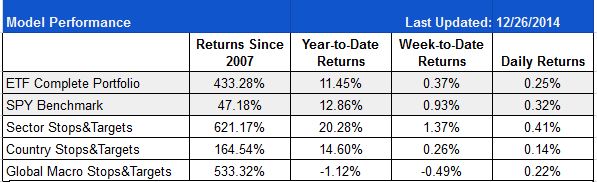
While the ETF Complete Portfolio spent most of the year out-performing the SPY benchmark, it now enters the last week of the year fractionally below this benchmark. The reason the model is not nicely outperforming lies in the “Global Macro” model which is down a percent year-to-date.
However, the Global Macro model should not be shunned for its flat performance this year. This third of the ETF Complete Portfolio offers some of the most diverse ETFs for profiting when stocks fall, as well as from markets that are very uncorrelated with stocks. Over the long run it has proven itself to be a valuable component of the Complete Portfolio.
Overall, the ETF Complete Portfolio has had a good year considering it is basically in line with the performance of the market despite the fact that 1/3 of the model underperformed significantly, and it has had a considerable percentage of its positions in cash. So with less cash invested, and with more diversity in its potential to profit, it has provided the same overall return. Everyone, myself included, always wants “more”, but that’s a job well done.
Go to the Model Portfolio to view breakdown of all the ETF Complete Portfolio’s current positions and past performance:
If you have any questions about getting started please drop us an email at: [email protected]
This Week’s Strategy Lesson: 6 Steps To Designing A System
Due to the Christmas holiday we do not have a new ETF Insight article. However, I have pulled one from our archives that offers a good lesson to begin the new year. Additionally, if you are interested in more information about these 6 steps to designing a system you can find the 7 part series of articles in the archives in the "Strategy Insights" section of your member area. They were posted in June 2014 time frame.
Let’s review our 6 steps to “Designing A Strategy” series this week. We spent seven weeks going through the process we used for designing and testing our ETF strategies. We thought it would be useful to review those steps and go over some of the more important things we have learned.
1) Have a Core Trading Concept
The core trading concept is the fundamental building block that gives your strategy the initial edge. Whether it’s moving average crossovers, pivot stacks, phase changes, or any number of other trading ideas, the key thing is that it provides a higher probability setup for trading. For our models, we focused on ways to implement our unique method for calculating trend strength and ranking.
This strategy gets its edge from the finding and trading the longer term economic trends within sectors and countries. Even so, we don’t have a strategy, let alone a refined strategy, until we complete the following steps.
2) Define/Expand list of Trading Instruments
One of the key next steps is determining your “investible universe.” Sometimes your strategy determines this. We at MarketGauge use a lot of screeners to find stocks among thousands of potential stocks that fit our criteria.
For the ETF strategies, we already determined the basic parameters: one strategy would be sector focused and the other would be country focused—and they both would include only ETFs. It still took some thought and testing to narrow that list down and answer questions like would we include leveraged funds or short exposure funds.
3) Money Management Rules
Money management is the set of rules, like capital allocation, trade frequency, and stops and targets that, when tuned properly, can turn a marginal strategy into a really strong strategy.
For our strategy, we wanted to tune it so that we would have the right level of concentration (we decided on three holdings) and pick up on the longer term trends. We recently added explicit stops and targets to both or our strategies. These are very liberal. They are designed to cap our max risk and get the most out or our trades without fundamentally altering the characteristics and performance of the strategies.
4) Create Rules To Avoid Bear Traps
Many strategies only work in particular market environments, either by design or because of a flaw. Traditional long only strategies work because the market tends to go up over time (due to both population growth and increasing productivity due to technological innovations), but they are also go down when the market has a pullback.
We specifically included short ETFs in our strategy and back-tested to make sure that the method we use for our trade signals would appropriately switch to short ETFs when the market is pulling back.
There is a lag between when the market starts pulling back and when we transition into the shorts, and of course, there are times where we make the transition and the market doesn’t follow-through, but including this in our strategy definitely improved our overall performance.
5) Calibrate your Indicators
At this stage in designing and testing a strategy, all variables are on the table. And it’s really the testing the interplay between the variables that makes that complicates this stage. Adjustments in one area can lead to vastly different results in another area. Data collection is important during this phase to help you determine what areas might be fruitful to look into further and what areas might be dead ends.
It is also important to determine the “robustness” of your variables. Ideally you would like to see similar results from the majority of your minor tweaking. If your strategy goes from the prince to the pauper with a minor change, you have probably stumbled upon a lucky coincidence in the market and not a repeatable phenomenon that you can bank upon in the future.
6) Diversification
The final key component we covered was diversification. It is one of the easiest ways to reduce the volatility of your strategy. Having multiple holdings/trades on at the same time reduces the impact of any single trade and averages out the results. You might not get the same return as non-diversified “hot” strategy, but no strategy stays hot forever, and you will get a proportionately higher return for your level of risk over any longer period of time.
I hope this outline gives you a better understanding of how and why our systems work the way they do. This also provides you an outline for developing and testing your own strategy ideas. We at MarketGauge are always observing markets and testing new ideas.
The Current Condition of the Model
The model is currently in 6 of the 9 positions with two positions in their buy zone. The last week of the trading year is likely to be slow. 2015 will have no shortage of interesting market conditions, and geo-political conditions to drive big trends for use to profit from.
For a complete listing of the positions and TSI rankings of all the ETFs please go to the Model Portfolio section of the ETF Complete Portfolio Member Area
Best wishes for your trading,
James Kimball
Trader & Analyst
MarketGauge