This Week’s Strategy Lesson: Guidelines for Constructing a Portfolio (Part 1)

Many of us like to focus on trading. It’s fast and exciting and can lead to quick profits. However, wise, longer-term investing is one of the keys to building wealth. A good portfolio takes thought and planning, not just throwing together a few random trades.
There are some tried and true methods for constructing solid portfolios. Our ETF Plus strategies are designed to work as or as part of a longer-term portfolio. Let’s go over some of these general principles and guidelines.
1) Commit to Investing Over the Long Term.
Managing a portfolio is about the “long game.” Both your strategy for allocating assets and your commitment to stick with the plan must be suited for that timeframe. The ETF strategies are designed to be complete strategies that should work well in most market environments—and just as importantly, work well if you actually trade them.
In addition to having the full range of long exposure options, the ETF strategies have short equity and long treasury exposure and a method for finding the trending ETFs in markets that are up, down, or sideways. The stronger a trending market (up or down), the stronger a model like this will likely perform, but it has tools to try and find the winners in any environment. This can mimic some of the traditional asset rotation that happens during different parts of the economic cycle in most managed funds.
While the model might be well-suited for the longer-term, you, the trader and investor must be committed to this same time horizon. If you are easily spooked out of positions or not willing to follow the rules, your results could be vastly different than those of the model. A key part of helping you stick with the plan is position sizing so that you can be comfortable with the volatility and still be happy with the return.
A balanced portfolio will have a combination of short and long term plays. Short term trades will catch the quick trends and pulse of the market while the long term investments are designed to catch the broad trends and big moves.
Sometimes the ETF strategies act as a little of both. Some signals we get a really timely entry or a quick pop in one of our holdings. But for the most part, the ETF models have a long time horizon with the average trade lasting a couple months, not a couple days or weeks. For a truly balanced portfolio, these strategies can be a big component, but probably shouldn’t be the only component.
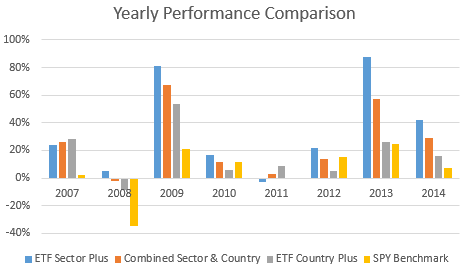
We specifically spent a great deal of time and effort backtesting our strategies all the way back to 2007—both so that we could make sure they performed well in a wide variety of market environments and because that type of long time horizon investing was part of our goal.
We wanted a strategy that would grow assets year in and year out and take advantage of the power of compounding and it appears that we achieved that goal. In 6 out the last 8 years, the models (particularly the combined models) outperformed the broader markets by a wide margin and in the other two years, within a couple percent, matched the market.
Next week we will continue this series with a discussion of guidelines for determining the appropriate asset allocation for a portfolio.
Best wishes for your trading,
James Kimball
Trader & Analyst
MarketGauge