November 30, 2025
Weekly Market Outlook
By Geoff Bysshe
When the market peaked at the end of October, the media’s market narrative was skewed to the idea that Nvidia was leading the market higher, and as a result, the fate of the much anticipated year-end rally rested in its earnings report.
Based on the chart below, this was an easy assumption to make.

Leading up to Nvidia’s earnings date, the market had surprised investors with one of its worst-performing Novembers in a decade, and then Nvidia surprised the market again.
However, the surprise was, well, not the expected surprise.
Only in investing does an “expected surprise” make sense, and fortunately, this one looks like it may have an unexpectedly bullish outcome.
Sorting out all this confusion begins with the fact that, despite what most investors are probably thinking…
In the S&P 500, NVDIA is far from being the leading stock for 2025. In fact, there are about 95 companies that are outperforming it this year.
So are investors right to assume that it holds the influence over the market that it once did?
Last week may have changed that assumption dramatically, and for the better.
Investors Have Been Selling Into Earnings
The Thursday (Nov. 20) selloff, sparked by NVDA earnings news that initially opened higher but culminated in a waterfall of selling, seemed almost certain to set up last week to continue the market’s 4-week down trend.
The market was most likely prepared for a gap higher and run, or even a gap lower and fall. Savvy investors were probably expecting a higher open followed by a selloff.
However, few likely expected the violent Thursday reversal to reverse on Friday and never look back the following week.
Even more unexpected was the fact that NVDA continued to fall while the market rallied.
Even the SMH closed last week above the NVDA earnings day high, while NVDA remained below the low of that fateful day.
Healthy Rotation or Dangerous Distribution?
It would be normal for the savvy investor to turn bearish based on the “bad market action” in NVDA and the market indexes on a day filled with “good news” from NVDA about its current earnings and future expectations.
Furthermore, the market correction had been precipitated by the Fed talking down the odds of a December rate cut, and the AI narrative had morphed from one of strong balance sheets fueling unprecedented capital investment to a fear of circular financing inflating excess spending with questionable chances it leading to a positive ROI.
The set up was textbook topping conditions.
However, most of the market turned higher the very next day.
Last week we reported that the 3-4 week decline leading up to the NVDA selloff was technically set up for a bounce.
The market did more than bounce, and while NVDA’s technical setup looked like a convincing “sell the good news” breakdown in the making, the market’s rotation and strength shouldn’t be surprising.
The market has been broadening out and gaining strength in new areas for months!
Stocks Beating NVDA
The S&P is up about 15.5% for the year. NVDA is up just under 30%.
In the table below, you can see the performance of the S&P 500 stock grouped by year-to-date performance. The green areas are performance groups that are greater than NVDA (29.79%), and the red areas are performance that is worse than the S&P 500 (16.5%),

More specifically, 11 S&P 500 stocks have gained between 70% and 329% this year. Below you’ll find a table of all stocks in the S&P 500 that have outperformed NVDA.
The list includes many different sectors and shows that most have not only out performed but also remain closer to their 52-week high.
| Companies With YTD % Return Greater Than NVDA | ||||
| Ticker | Last | YTD (%) | Sector | % From High |
| SNDK | $223.28 | 329% | ElectronicTechnology | -22% |
| WDC | $163.33 | 261% | ElectronicTechnology | -8% |
| HOOD | $128.49 | 233% | Finance | -16% |
| STX | $276.69 | 217% | ElectronicTechnology | -7% |
| MU | $236.48 | 178% | ElectronicTechnology | -9% |
| NEM | $90.73 | 138% | NonEnergyMinerals | -8% |
| WBD | $24.00 | 125% | ConsumerServices | -1% |
| PLTR | $168.91 | 122% | TechnologyServices | -19% |
| LRCX | $156.00 | 115% | ProducerManufacturing | -7% |
| APH | $140.90 | 101% | ElectronicTechnology | -2% |
| INTC | $40.56 | 100% | ElectronicTechnology | -5% |
| NRG | $169.49 | 86% | Utilities | -6% |
| HWM | $204.59 | 86% | ElectronicTechnology | -3% |
| KLAC | $1,175.47 | 85% | ElectronicTechnology | -8% |
| APP | $601.40 | 82% | TechnologyServices | -19% |
| IDXX | $752.88 | 80% | HealthTechnology | -2% |
| GEV | $599.75 | 80% | ProducerManufacturing | -11% |
| CAH | $212.26 | 79% | DistributionServices | -1% |
| CVS | $80.36 | 78% | RetailTrade | -6% |
| AMD | $217.52 | 78% | ElectronicTechnology | -19% |
| GE | $298.31 | 78% | ElectronicTechnology | -6% |
| GLW | $84.19 | 77% | ElectronicTechnology | -9% |
| AVGO | $403.37 | 71% | ElectronicTechnology | 0% |
| GOOGL | $320.18 | 68% | TechnologyServices | -3% |
| HCA | $508.29 | 68% | HealthServices | -2% |
| GOOG | $ 320.12 | 67% | TechnologyServices | -3% |
| TPR | $109.26 | 67% | RetailTrade | -8% |
| WELL | $208.30 | 66% | Finance | 0% |
| HII | $313.62 | 65% | ProducerManufacturing | -5% |
| COR | $ 368.93 | 63% | DistributionServices | -2% |
| CEG | $364.36 | 61% | Utilities | -12% |
| RL | $367.33 | 58% | ConsumerNonDurables | -2% |
| TEL | $226.15 | 58% | ElectronicTechnology | -10% |
| CAT | $575.76 | 58% | ProducerManufacturing | -3% |
| MCK | $881.12 | 54% | DistributionServices | -2% |
| MPWR | $928.17 | 54% | ElectronicTechnology | -17% |
| AMAT | $252.31 | 53% | ElectronicTechnology | 0% |
| FSLR | $272.92 | 53% | ElectronicTechnology | -3% |
| CHRW | $158.83 | 53% | Transportation | -1% |
| ALB | $129.99 | 50% | ProcessIndustries | 0% |
| INCY | $104.46 | 50% | HealthTechnology | -4% |
| RTX | $174.78 | 49% | ElectronicTechnology | -4% |
| WYNN | $128.68 | 49% | ConsumerServices | -4% |
| CRWD | $509.25 | 47% | TechnologyServices | -10% |
| DLTR | $110.81 | 47% | RetailTrade | -6% |
| IBKR | $65.02 | 46% | Finance | -11% |
| HAS | $82.60 | 46% | ConsumerDurables | -1% |
| C | $103.56 | 46% | Finance | -2% |
| STLD | $167.83 | 46% | NonEnergyMinerals | 0% |
| PWR | $464.88 | 46% | IndustrialServices | -1% |
| JCI | $116.28 | 46% | ProducerManufacturing | -6% |
| JBL | $210.71 | 46% | ProducerManufacturing | -11% |
| BK | $112.10 | 45% | Finance | -1% |
| DG | $109.50 | 44% | RetailTrade | -7% |
| TER | $181.90 | 44% | ElectronicTechnology | -5% |
| VLO | $176.76 | 43% | EnergyMinerals | -5% |
| GS | $ 826.04 | 43% | Finance | -2% |
| JNJ | $206.46 | 42% | HealthTechnology | -1% |
| CMI | $497.98 | 42% | ProducerManufacturing | 0% |
| MNST | $74.99 | 42% | ConsumerNonDurables | 0% |
| UBER | $87.56 | 41% | Transportation | -14% |
| IBM | $308.42 | 39% | TechnologyServices | -5% |
| IVZ | $24.45 | 38% | Finance | -1% |
| ROK | $395.86 | 38% | ProducerManufacturing | -1% |
| MPC | $193.77 | 38% | EnergyMinerals | -4% |
| GM | $73.52 | 38% | ConsumerDurables | 0% |
| PSKY | $16.02 | 38% | ConsumerServices | -23% |
| VTR | $80.66 | 37% | Finance | 0% |
| LLY | $1,072.43 | 37% | HealthTechnology | -4% |
| EA | $202.03 | 37% | TechnologyServices | -1% |
| EXPE | $255.69 | 36% | ConsumerServices | -9% |
| TKO | $193.89 | 36% | ConsumerServices | -9% |
| GILD | $125.84 | 36% | HealthTechnology | -2% |
| NUE | $159.49 | 35% | NonEnergyMinerals | 0% |
| EME | $615.07 | 35% | IndustrialServices | -21% |
| PH | $861.70 | 35% | ElectronicTechnology | -1% |
| UHS | $243.63 | 35% | HealthServices | -1% |
| FOXA | $65.50 | 34% | ConsumerServices | -3% |
| MS | $169.62 | 34% | Finance | -1% |
| F | $13.28 | 34% | ConsumerDurables | -5% |
| EBAY | $82.79 | 34% | RetailTrade | -18% |
| AEP | $123.77 | 34% | Utilities | -1% |
| TTWO | $246.03 | 33% | TechnologyServices | -7% |
| LVS | $68.16 | 33% | ConsumerServices | -1% |
| LHX | $278.69 | 33% | ElectronicTechnology | -10% |
| EXPD | $146.90 | 32% | Transportation | -1% |
| MMM | $ 172.07 | 32% | ProducerManufacturing | 0% |
| ROL | $61.49 | 32% | CommercialServices | -1% |
| WRB | $77.69 | 32% | Finance | -2% |
| AMGN | $345.46 | 32% | HealthTechnology | 0% |
| CBOE | $258.17 | 31% | Finance | -2% |
| LDOS | $191.10 | 31% | TechnologyServices | -7% |
| MDT | $105.33 | 31% | HealthTechnology | -1% |
| JPM | $313.08 | 30% | Finance | -3% |
| CSCO | $77.01 | 30% | ElectronicTechnology | -4% |
| NVDA | $176.51 | 30% | ElectronicTechnology | -17% |
This list shows that the market has strong and broad leadership that has been trending for months.
The November Rally
Last week’s rally was led by the year’s leading group, SMH, but it wasn’t alone in extraordinary gains.
As you can see in the chart below of major sectors, indexes, and themes, biotech, retail and small caps also led the way higher.

November was expected to be a strong month, but the QQQ never closed higher MTD and the SPY never closed over the high of its first trading day of the month.
There was plenty of strength, but I doubt many investors would have expected a distribution of returns like you see below.
Even after leading the market higher last week, SMH, was one of the worst performing and losing sectors for the month.
The equal-weighted S&P 500 and Nasdaq ETFs, RSP and QQEW, outperformed their cap-weighted counterparts.

The AI Chip Dominance Is Broadening Out
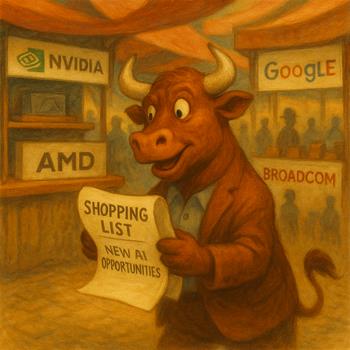
Last week Google got a lot of attention around the release of its new Gemini 3 AI platform and for the fact that its latest models were trained using its own AI Chips (not Nvidia’s).
This attention is well deserved, but the market also sent a loud and clear message that the next wave of AI development is not dependent on Nvidia and, more importantly, not dependent on any one specific chip type.
Like many technologies, especially semiconductors, there are many different types, and each has its own best use case. As AI develops so will the number of chip suppliers.
It’s hard to stay on top of all the developments in the semiconductor industry, but it was not hard to see, INTC, GOOGL, and AVGO rocketing higher and NVDA struggled.
Below is a table summarizing chip making initiatives by major public and private companies in addition to Nvidia.

Investors Should Follow The K-Shaped Economy
The market’s message last week and in November was one of a broadening bull market in two major areas.
In AI chip technology as shown above, and in the K shaped economy.
The market peaked about 4 weeks ago in part because the Fed was sending a strong message that a December rate cut was not as guaranteed as the futures market was suggesting. Expectations for a December cut and the market fell in tandem in November.
The K shaped economy implies that there is a segment of the population that can afford to continue to support the consumption component of economy. However, the Fed is still focused on the lower income part of the “K” that needs the support that lower rates may provide.
As a result, the Fed is likely to lean towards cutting even if the economy feels strong, so long as it’s able to justify its second mandate of keeping inflation in check. Early last week, the Fed governors indicated that a December rate cut was likely, and the market changed its expectations to reflect this.

Better-than-feared earnings reports from key retailers, combined with higher expectations for rate cuts, allowed investors to aggressively buy the NVDA dip, expecting the solid earnings growth trends of the last few years to continue.
As you can see in the chart below, the blue line represents forward earnings of the S&P 500 ex-the Mag7 ramping up at the end of 2025. This trajectory is expected to continue into 2026.

The fundamental argument that overspending by the tech sector will lead to a bear market can spook the market, but it’s not likely to sink it without a real threat of a recession in earnings or GDP.
If the Fed is accommodating growth and the market’s message during a correction is a one of “rotation” rather than a significant “distribution”, manage your risk and look for opportunities to “buy the dip.”
If you’d like help doing it yourself or having it done for you, contact us!
Happy Thanksgiving!
Geoff Bysshe
 |
 Every week we review the big picture of the market's technical condition as seen through the lens of our Big View data charts. Every week we review the big picture of the market's technical condition as seen through the lens of our Big View data charts.
The bullets provide a quick summary organized by conditions we see as being risk-on, risk-off, or neutral. The video analysis dives deeper. |
Summary: The market flipped broadly risk-on as all major indexes reclaimed bullish phases, sectors rallied across the board, metals surged—especially silver breaking a 45-year high—and internals like the McClellan Oscillator and new highs/lows strengthened alongside easing volatility and rates. Despite Nasdaq lagging slightly and mixed holiday-week volume, the “Modern Family,” global equities, and gold all showed strong momentum, while seasonal and cross-asset signals remain neutral but not bearish.
Risk On
Neutral
Risk Off
Go long SPY, QQQ, and DIA with full allocations, as all indexes have re-entered bullish phases and momentum is not overbought.
Increase IWM exposure to overweight (by +10–20% relative to baseline) given the strong phase shift, improving internals, and accumulation bias in volume.
Because every sector turned positive but leadership rotated, shift weight toward sectors showing new relative strength:
Overweight (+2–4%)
Maintain Core Weight
Underweight (–2–3%)
Silver
Gold
Broad Commodities
With both emerging and developed markets back in bull phases:
Modern Family is broadening out—this supports a “risk-on rotation” approach.
Add new positions in:
Reduce allocation slightly in:
Rates eased this week and appear to be retesting recent multi-year highs.
Trade:
Bitcoin bounced from oversold RM but continues lagging major indexes.
Plan:
Risk gauge moved to neutral, not fully risk-on.
Therefore:
This is a broad risk-on environment with strong confirmation from phases, internals, metals, and global markets—so the plan is to increase exposure, rotate into newly emerging leaders, add metals, maintain a cash buffer due to the neutral gauge, and tighten stops under recent MAs.

Every week you'll gain actionable insight with: