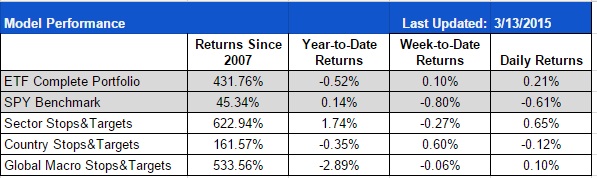
The ETF Complete portfolio ended the week basically flat, up +0.10%. While this isn’t a great return, it did hold up well this week while the SPY had its third week of losses in a row.
We made two position changes this last week, selling out of FXI and rotating into EWJ in the Country model while we exited DRN and rotated into IBB in the Sector model. Both of those new position changes ended in the green this week from our entry price.
Go to the Model Portfolio to view breakdown of all the ETF Complete Portfolio’s current positions and past performance:
If you have any questions about getting started please drop us an email at: [email protected]
This Week’s Strategy Lesson: Momentum (Part 1)
When asked one time if making money in the markets was difficult, Jessie Livermore (the semi-biographical protagonist in “Reminiscences of a Stock Operator”) famously responded:
“Not at all! I have found an easy way and I stick to it. I simply cannot help making money. I will tell you my secret if you wish. It is this: I never buy at the bottom and I always sell too soon.”
Everyone has heard that to make money in stocks you have to buy low and sell high. And while technically, at the very least you do have to sell higher than you bought to make a profit, the usual connotation of “buying low” (relative to recent prices or support levels) is not always a home run.
The truth of the matter is we never know if that recent new high in a stock will be the new all-time high or just another step on its way up. And likewise, unless a stock is at zero, you cannot be sure it has bottomed out. Stocks are never too high to buy or too low to sell if you have good reasons.
We all have some innate fear about buying a stock on a fresh new high. Talk to anyone who has been trading long enough and its almost guaranteed they will have a story about the time they sold the all-time low in coffee or bought the all-time high in a tech stock.
The ETF models can put our fears to the test. At its core, the models are about being in the strongest TSI (Trend Strength Indicator) ETFs. This generally means the ones we get into have had a period of strong performance. They might not always be at new highs, but they will typically already have made a nice move before we get into them.
The models made a number of great trades that fit this description in the last year.
The Sector model bought ERX last April just as it was breaking out to new all-time highs. It didn’t feel great buying it at those levels, but if you had hesitated, you would have missed over a 25%+ move.
The Country model has a similar looking trade in India. It had already moved over 20% off its consolidation around $18. The move felt quick and overdone. But the model insisted on entering a trade and we have now been in it almost a year approaching a 40% gain from our entry.
However, these trades don’t always work. TMF is a good example of both a trade working and a trade not working. The Country model entered last April and is still in the trade sitting on a very nice gain. The Sector Model has had less luck. While it did have an earlier trade that worked well last October, the recent entry proved quite untimely.
The ETF models taken as a whole gives us the opportunity to be in a wide variety of instruments, from leveraged sector ETFs to small emerging markets to the U.S. Dollar. While each of these have different trading characteristics, we are consistently entering these instruments when they are showing strength and making moves. This can open us up to nice quick profits when we are right, and also our share of ETFs that can move off their highs just as quickly sometimes. That is one of the unavoidable aspects of a momentum-based strategy.
We have seen here a few great examples where buying strength, even buying new highs has worked. But why does it work? What forces are working in our favor to help give us our edge? In the next couple of articles, we are going to explore the underlying reasons that causes stocks and ETFs to trend up or down and how our TSI helps us pick up on which ETF might be the next to sprint away from the pack.
The Current Condition of the Model
There are no position changes on the immediate horizon. SOXL, TAN (1/2 position), and QQQ are all in the buyzone
For a complete listing of the positions, and TSI rankings of all the ETFs please go to the Model Portfolio section of the ETF Complete Portfolio Member Area
Best wishes for your trading,
James Kimball