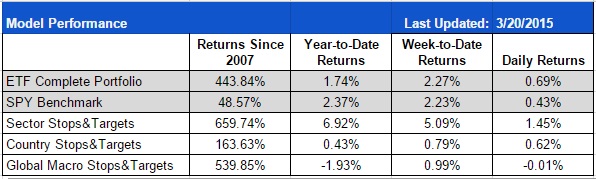
The ETF Complete portfolio ended the week positive, up over two percent, basically matching the SPY. On the year, the SPY still holds a narrow lead.
There were no position changes this week. We had some strong gains in CURE, IBB, SOXL, EWJ, TAN, and QQQ. The two laggards this week were IFN which pulled off its recent highs and the dollar (UUP) pulled back sharply after the mid-week FED announcement..
Go to the Model Portfolio to view breakdown of all the ETF Complete Portfolio’s current positions and past performance:
If you have any questions about getting started please drop us an email at: [email protected]
This Week’s Strategy Lesson: Momentum (Part 2)
Last week we began this series on momentum looking at some of the trades the ETF models put us in last year. Many of them were at all-time or multi-year highs. But even the trades that weren’t on new highs had one thing in common, we bought them on strength.
There is a fair amount of research out there about the efficacy of momentum-based investing and trading. James O’Shaughnessy’s best-selling book, “What works on Wall Street” is one of the best places to start researching this topic (O’Shaughnessy currently manages 6.5 billion at the asset management firm he founded).
In his book, he takes a wide-view approach, looking at “big data” from thousands of stocks between 1927 and 2009 (latest edition of the book) and from multiple perspectives including fundamental and value investing to pure momentum.
Each method has it merits and works better or worse in different market conditions. However, without question, he found that buying stocks that have had the best price appreciation over certain periods proved to be the top performing strategy.
For instance, he looked at ranking stocks with a simple six month return and found that buying the top decile (top 10% of rankings) of stocks based on six month return, over the entire sample period of 82 years resulted in an average annual return of 17.6% versus 13.1% for all stocks—a nearly 35% higher annualized return.
Furthermore, the top decile beat the all stocks group in 87% of all five-year rolling periods and 98% of all ten-year rolling periods (though it was not without some nasty drawdowns and had several multi-year periods where it underperformed).
The chart above shows the excess annualized returns of a portfolio of the top decile stocks rated by six month momentum versus the all stocks group from January 1927 to December 2009, taken from “What Works on Wall Street,” 4th edition, 2012 Page 411.
This is a strong result and the edge from this strategy is persistent and survives decade after decade of stock data. However, in this form, we still do not have a completely viable or trade-able strategy.
O’Shaughnessy is looking at big data. To get precisely these results would require you to buy perhaps hundreds of stocks and hold them for an indeterminate amount of time—a strategy that isn’t viable for individual investors and traders. You would also have to potentially subject yourself to some intolerable equity swings. The largest drawdown in his simple strategy was over 78%.
We have now seen both some of our own ETF trades that demonstrate the power of buying strength as well as some broad statistical data to back this up. But what fundamental or real world phenomenon causes stocks to behave this way? In next week’s continuing article in this series we will delve headfirst into trying to answer this question.
The Current Condition of the Model
There are no position changes on the immediate horizon.
No ETFs are in the buy zone.
For a complete listing of the positions, and TSI rankings of all the ETFs please go to the Model Portfolio section of the ETF Complete Portfolio Member Area
Best wishes for your trading,
James Kimball