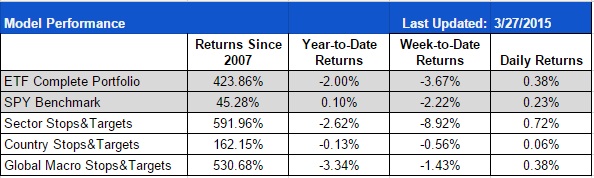
Both the ETF Complete portfolio and its benchmark, SPY, ended the week negative with the ETF Complete underperforming by a little over 1%. We were stopped out of one of our positions, SOXL, after a large four-day selloff. Unfortunately for the model, the ETF recovered a portion of those gains on Friday after rumors that Intel was in talks to acquire Altera.
The SPY closed the week down over 2% and remains in a rather precarious situation breaking below the 50 DMA this week and right back into the middle of the price action for the last five months.
A number of ETFs in our holdings remain close to being replaced. There is the possibility of a new position taking the place of SOXL on that ETFs weakness. IFN continues to underperform and it seems likely that if the trend continues, it may finally be replaced next week. Currently, EWG (Germany) would be the ETF to replace it. And finally, QQQ in the global macro model would likely be replaced in the broader markets continue to selloff next week.
There was a live coaching webinar this week. A recording of the webinar is available in the members area.
Go to the Model Portfolio to view breakdown of all the ETF Complete Portfolio’s current positions and past performance:
If you have any questions about getting started please drop us an email at: [email protected]
This Week’s Strategy Lesson: Momentum (Part 3)
We are now in the third part of this series looking at the concept of momentum in financial markets. We first looked at a few examples of ETF model trades that showed how momentum can push an ETF to new highs. Last week we saw that price appreciation by itself can be a reliable signal about continued and future gains. However, we still haven’t really addressed the underlying causes of this relationship.
Three Types of Systems
In economics, we talk a lot about system design. Knowing how different components inter-relate to each other can teach us a lot about why things react the way they do and a little about predicting what might happen next. While the ETF models focus on primarily on one of these systems, it is helpful to have some understanding of how they operate.
Homeostatic Systems
A homeostatic system is a self-balancing system. What this means is that when a change occurs, there are automatic processes that kick-in to bring the system back into alignment.
Your thermostat in your house is a great example of this type of system. When the temperature increases outside, the thermostat signals to the air conditioner to provide cool air which brings the temperature of the house back down to the desired level. And on the opposite side, when the temperature drops, the thermostat turns up the heat to once again bring the temperature back to its equilibrium point.
Fiscal and monetary policy, when done right, is also designed to create a homeostatic environment. When the economy is faltering, unemployment benefits, stimulus, and easy money help to smooth out and reduce the dip. While, when the economy is roaring, increased tax revenues and tighter monetary policy should help to prevent or dampen any “irrational exuberance.”
Chaotic Systems
A chaotic system, as the name suggests, is one where we either cannot discern or cannot predict the underlying factors that are causing changes. While there is a large technical difference between a “random” system and a “chaotic” system, that distinction is not particularly useful here.
These systems are characterized by large out-sized or unpredictable changes or responses to seemingly small initial differences. Some systems can appear random or chaotic until we learn the underlying processes, but there remains a large set of phenomena that is beyond our ability to make any meaningful predictions.
Positive and Negative Feedback Systems
A positive or negative feedback system is one where there are fewer or no counter-acting forces to bring the system back into equilibrium. Without the counter balancing effects, an initial positive or negative shock can gain momentum and cause increasingly larger positive or negative effects.
A negative or “vicious” cycle can be seen in the subprime mortgage crisis of 2008. A large number of zero-down home loans were made to borrowers with poor credit history. When home prices had an initial drop, these borrowers found themselves “underwater” on their homes, creating situations where they were better off walking away from their homes.
This increased the number of houses on the market, lowering home prices further. Causing more and more people to walk away from their homes. Which lead to banks becoming insolvent and drastically reducing lending activities. Which lead to lower economic activity and eventually job cuts. Causing more people to be unable to make their mortgage payments. And on and on the cycle goes – this one at least until the markets had worked off the excess or the countervailing forces had sufficiently taken hold. (Mortgage-backed securities and credit default swaps amplified these negative effects in the banking system).
With positive feedback/momentum systems, we have finally arrived at one of the main driving forces for the ETF models. India is a great example of a positive feedback result in the last year.
Last April, India elected a new prime minister, Narendra Modi, on the platform of economic reforms. Even the mere prospect of reforms can start a “virtuous” cycle as businesses become aware of increased opportunity and international investment begins flowing into a country. This leads to higher GDP and more government revenues that can be reinvested in infrastructure and education, further amplifying the benefits of foreign investment.
In markets, we can see all of these systems at work at different times. Sometimes markets are trending, sometimes they are consolidating, and sometimes external factors like geopolitical events can cause them to become completely erratic.
We use the TSI ranking concept in our ETF models to attempt to find the ETFs that are in a positive feedback cycle regardless of the broader market conditions. To find the sectors or countries that are benefitting from positive forces like technological breakthroughs or economic reforms.
Next week we will look deeper at some of our current and recent holdings to try and identify some of these forces and look at how the TSI score can help us find areas where positive trends are emerging.
The Current Condition of the Model
SOXL was stopped out of the model on Thursday. That position will remain in cash until a fresh signal is generated.
QQQ is currently in the Buy Zone.
For a complete listing of the positions, and TSI rankings of all the ETFs please go to the Model Portfolio section of the ETF Complete Portfolio Member Area
Best wishes for your trading,
James Kimball
Trader & Analyst
MarketGauge