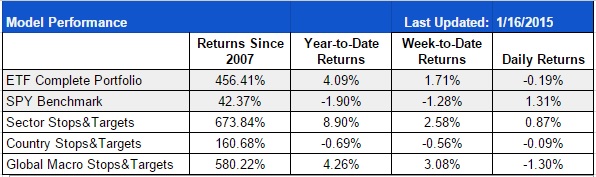
The ETF Complete portfolio outperformed the SPY by over 2% again this week despite remaining in almost 40% cash. Once again contributions by DRN bolstered the Sector model and gains in TLT and VXX helped the Global Macro lead the way.
The portfolio is still positioned somewhat cautiously and will tend to lag the market on very bullish days due to its large cash and alternative ETF apportionments. The broader market tried to make a case that it is trading in a range, hitting the lower end and bouncing off of it on Friday. While making a nice comeback from mid-week lows, the market remains suspect..
Go to the Model Portfolio to view breakdown of all the ETF Complete Portfolio’s current positions and past performance:
If you have any questions about getting started please drop us an email at: [email protected]
This Week’s Strategy Lesson: Rebalancing (Part 1)
Everyone knows about the importance of balance in life. It’s the natural course of things for something to become temporarily more important or out of proportion over time and have to be brought back into perspective. It is the same with trading.
Each of our ETF models (sector, country, global macro) start with three equal-sized positions. One of our money management rules is that when you rotate out of a position into a new one, you keep the new position the same size as the one you just rotated out of. This is necessary to keep all of your money invested in the three positions without having to keep extra cash in your account.
However, as time progresses and different positions have different returns, your relative position sizing in each portfolio slot can become out of balance. It can often take a while for this to happen, but I think you would be surprised how quickly it can happen when the ETFs performance completely diverge. You can easily end up with a situation where a majority of your risk is in one position and the other two positions have to really outperform to make a meaningful contribution to your overall performance.
For this article, I used data from ETF Country Plus model, but the results would be similar for any of the other models. If, back in 2007, you started following the model and divided your money evenly between the three positions and you never rebalanced you would end 2014 with the largest position being almost double the size of your smallest position versus if you followed one of our recommended rebalancing rules, they would all be about the same size.
In addition to this affecting your “diversification” and potential risk from a singular move in one position, it can also affect your performance. In the scenario above, a new trade in the 22% portfolio slot would have to perform nearly twice as well as if you put that same trade in the 42% portfolio slot to give you same contribution to your overall gains. That can be a tall order for any trade.
As you can see from the chart above, if you never rebalanced, it would have reduced your overall performance in this dataset by almost 15% compared to the average of the three different rebalancing settings shown. So we know that it’s important to rebalance, especially if you are looking at longer timeframes.
But what should be the rule for how frequently you rebalance? Is there any real advantage to one methodology over another? Believe it or not, you have to “balance” how frequently you rebalance against other concerns, like the costs of executing the rebalancing plan.
The three scenarios shown in the chart are rebalancing when the largest (or smallest) position is 25% bigger (smaller) than the other two, 50% bigger, and 5% bigger. As you can see from the chart above, these three methods basically produced about the same equity performance, but the costs of executing them would be very different.
The 50% difference method would have resulted in rebalancing only 3 times over 8 years. The 25% difference method would have rebalanced 15 times over that period. And the 5% difference method would have had to rebalance a whopping 258 times!If you assumed an average trading commission cost of $7 that’s a difference between the cost of $63 to balance your portfolio for the least frequent method and $5,418 for the most frequent method—with no real discernable performance benefits between them. And that’s not taking into account the extra time and mental effort to execute those plans.
The findings here have generally been consistent with all of our other research on the topic. That 1) you should rebalance and 2) that it doesn’t matter much how frequently you rebalance above a baseline level. Whether you decide to use a “percent difference” method or perhaps a calendar based method (annually or semi-annually for instance), you should expect either method to work satisfactorily.
If you are just getting started, this will not be much of an issue, however, if you have been following our system for the last year and have not already been aware or using some methodology to keep your position sizes roughly equal, it may be time to give this some consideration.
Now that you know you should rebalance, how exactly is this done? While it doesn’t have to be complicated, there are a few moving parts and it would be good to go through some scenarios. Next week, in part two, we will walk through the mechanics of rebalancing a couple typical ETF model portfolios.
The Current Condition of the Model
The model is currently in 6 of the 9 positions.
EUM and FXI are in the buy zone.
For a complete listing of the positions, and TSI rankings of all the ETFs please go to the Model Portfolio section of the ETF Complete Portfolio Member Area
Best wishes for your trading,
James Kimball
Trader & Analyst
MarketGauge