This week we made one position change in the ETF Country model. On Friday morning we sold out of IFN on the open and entered into an equal sized position in EWP (Spain). Our current three positions are EGPT, TMF, and EWP. To open next week, we will remain in those three ETFs.
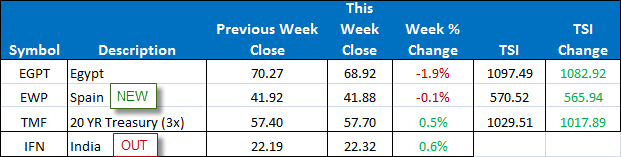
The MSCI World Index closed the week basically flat -0.03%. The ETF Country Plus model ended the week down -0.49%. The ETF Country Plus Strategy is up +9.06% year-to-date compared to its benchmark, the MSCI World Index, which is now up +1.98% year-to-date.
This Week’s Strategy Lesson: Designing a Strategy (Part 3)

We are now a few weeks into a series of articles on the process of designing robust strategies that can beat the market. In the first article we discussed starting with a central concept that gives you an edge. For our ETF models it was the concept of relative price momentum and trend persistence.
Last week we focused on the important considerations involved in defining our universe of trading instruments. This week we will cover the next step we went through in designing the ETF models.
Rules to Avoid the Bears and Find the Bulls in Any Market
All trading systems have limitations. A trading system by definition reduces the near infinite complexities of markets to just a few rules or indicators. Focusing is required but it can also leave you vulnerable to changes in market dynamics or trends.
Using trend strength to determine what ETFs to get in and out of proves to be a very strong tool, but what happens if we enter a prolonged bear market where all the sectors or countries are trending down. The three strongest ETFs during this period might still be doing “better” than the others but the fact is on an absolute basis, they might be losing money.
Being down 30% when the market is down 40% might be “outperforming” the market, but when we sat down to design the ETF model, we wanted to both get great outperformance on a relative basis but just as importantly, to get solid performance on an absolute basis.
We needed to add another layer of specificity to our model to help it navigate a bear market. To achieve this goal, we added the rule that if the trend strength indicator went negative, we would exit out of that position and we wouldn’t consider a new entry until it became positive again.
This would mean that in 2008, when nearly all of the traditional long ETFs went negative on the trend strength indicator, we would be in all cash for the model. In this prolonged scenario, the zero percent return on cash was actually outperforming every country fund in our model.
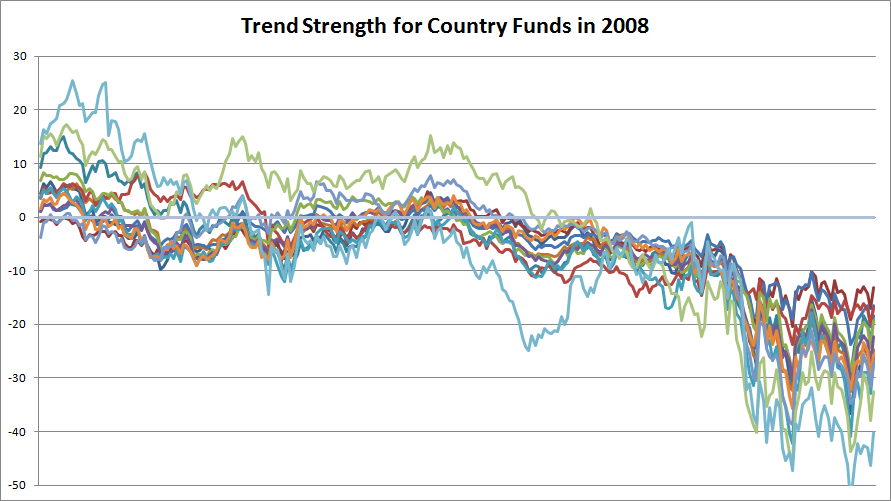
Our simple rule of not being in any position that has a negative TSI value keeps us out of the market when conditions aren’t ideal, and thereby improves performance of the model while making it easier (emotionally) to trade
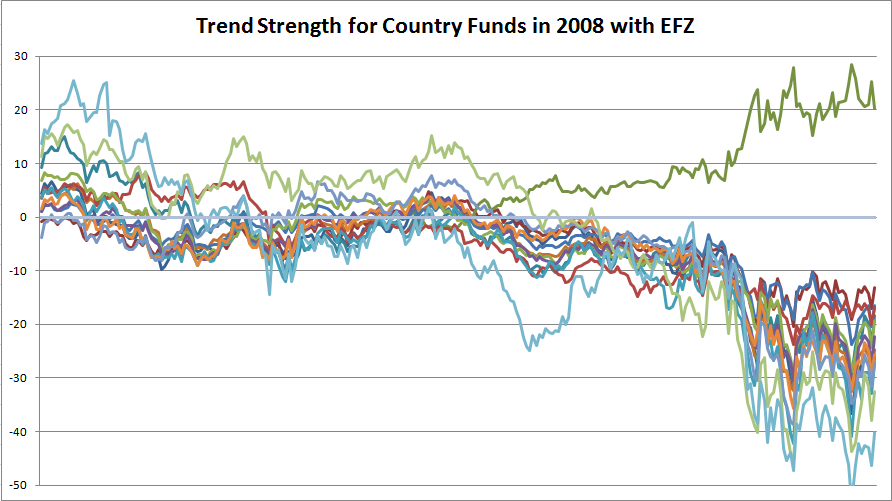
There is, however, one additional feature that really helps us navigate bear markets. Last week in our discussion of trade instrument selection, we talked about how including negatively correlated ETFs (ETFs that tend to move in the opposite direction of the broader market) could bolster our returns.
The chart below takes that same portfolio of long only country funds and adds one additional etf, EFZ (Short Developed Markets). You can now see that our old portfolio that would have spent a prolonged period in cash, with just the simple addition of EFZ, now has a valid trading instrument during the bear market.
Our new rule combined with a thorough selection of trading instruments had just given us a way to avoid the bear laggards and find bull leaders.
Our model is starting to come together, but I would bet we can continue to improve upon it. Stay tuned next week as we add a money management component to our strategy.
The Current Condition of the Model
For the country model, we are now in EGPT, EWP, and TMF. Our time in Spain may be limited. As the model uses end of day data, there are occasional times where major premarket moves can play games with the rankings.
IFN, which we exited out of at the open, had a major gap open today. We benefited from this higher exit price, but it also pushed up the TSI to move it back into third rank. Our internal fudge factor means that we will not get back into it immediately, but another day or two of contrary motion between IFN and EWP could force another swap. Stay tuned to the daily updates for any changes.
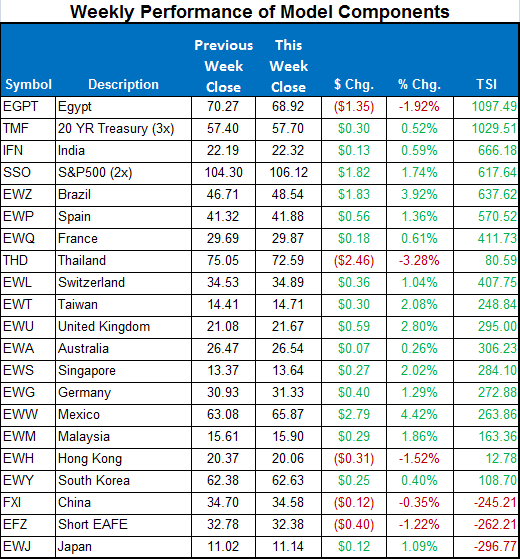
Here is a summary of the weekly performance of all the ETFs that the strategy monitors:
Best wishes for your trading,
James Kimball
Trader & Analyst
MarketGauge