This week we introduced the ETF Country Plus model. Our current three positions are EGPT, IFN and TMF. To open next week, we will remain in those three ETFs.
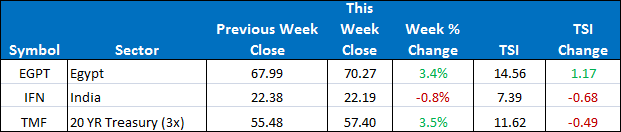
The MSCI World Index closed the week essentially flat, down -0.3%. The ETF Country Model ended the week up 2.0%. The ETF Country Plus Strategy is up +7.7% year-to-date compared to its benchmark, the MSCI World Index, which is now up +2.8%.
This Week’s Strategy Lesson: ETFs in Motion Tend to Stay in Motion

The ETF models we designed at MarketGauge are based on one fundamental concept: Trend Persistence. Or another way of saying that, to paraphrase Isaac Newton: “ETFs in motion tend to stay in Motion.” The simplicity of the concept belies the myriad and complex reasons for why it works. Let’s explore some of these reasons.
As we have discussed in some of our webinars, trends in sectors or countries persist because of underlying fundamental, often “big picture” changes. They can be changes in demographics, economic development, education, geopolitical situations, liquidity cycles, technological innovations, changing consumer preferences, wars, and even rumors of wars. These big picture changes often result in big, tradable moves in the ETFs that track them.
One of the larger ones we have experienced recently is the rise of China. As economic development increases, social and political freedom is expanded, and education becomes more common, these factors can come together and reach a “tipping point” where their effect begins to compound and accelerate. The “network” effect exponentially increases the effects of incremental improvements.
For example, a small increase in education can suddenly lead to a big increase in capital flowing into a country to employ the more educated workforce in complex modern factories. Or a small increase in transportation infrastructure suddenly allows corporations to cheaply ship goods to foreign markets causing an explosion in manufacturing output.
The effect can be the same in industries and sectors. When Apple stepped out ahead of the market and created the first iPhone, it started a revolution that revitalized the semiconductor industry, creating almost out of thin air, a market for a billion smart phones all needing faster and smaller and more energy efficient processors. These trends make excellent trades and the ETF models are designed to pick up on them.
All of these trends share a common theme, persistent growth over time. As we have talked about in the liquidity cycle, like a river flows downhill, capital flows to where it can get the highest return. So as these trends develop and get stronger, capital flows into these countries or sectors. This is why a trend persistence model works.
Of course, not every trend will persist. And identifying a key market concept only gets you half way to your goal. Trading styles, rules, and money management are required to turn that edge into a profitable system. Next week I will go into greater detail about how we took the trend persistence concept and turned it into a strategy.
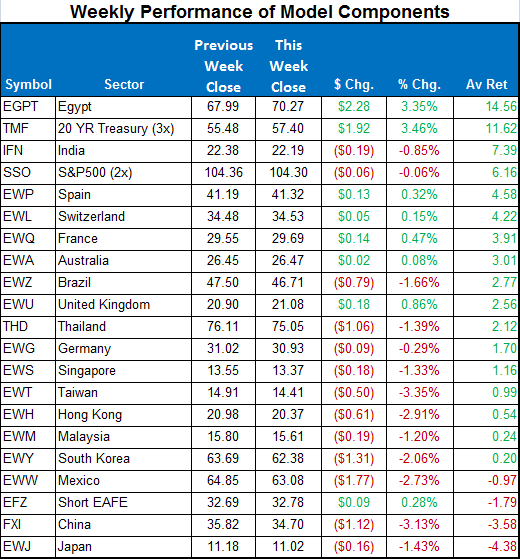
For the country model, we will continue to hold EGPT, IFN, and TMF. The SSO (2x leveraged S&P500) is now ranked 4th. The broader U.S. market is still waffling between looking strong for a continuation of the long-term trend and breaking support levels at the lower end of its range. Depending on where markets go from here, SSO would be the most likely substitution. Stay tuned to the daily updates for any changes.
Here is a summary of the weekly performance of all the ETFs that the strategy monitors:
Best wishes for your trading,
James Kimball
Trader & Analyst
MarketGauge