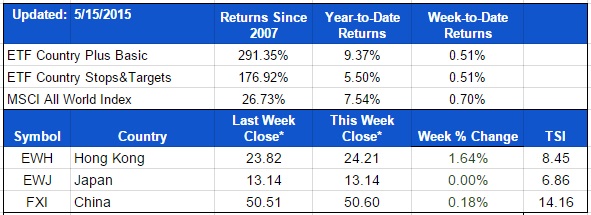
Both ETF Country models marginally underperformed their benchmark this week, up +0.51% vs the MSCI All World Index up +0.7%. All three of our holdings have exposure to Asian equities, which underperformed most of the week only to come barreling back on Friday.
The U.S. markets sold off into the first couple days of the week before it put in a few positive days and just barely edged out a new all-time high close on the SPY Friday.
This Week’s Strategy Lesson: Global Capital Movement (Part 2)
Last week we began this series with a brief overview of the global markets and where they stand. International markets have outperformed the U.S. markets this year. Some of this capital movement is tied to the unique situations in each region. Other capital movement can be linked to relative valuations. As the bull market in the U.S. ages and valuations become fair or rich, investors and money managers naturally start to look around the world for return.
Global capital flows can have similar characteristics as capital flows in domestic markets. The profit motive drives most of these changes. Workers change jobs or industries and learn new skills to earn higher salaries. Companies develop new products, improve efficiency, and enter new markets to increase profits. And governments change economic policies and attempt to improve business conditions to attract international capital, improve living conditions, and grow GDP.
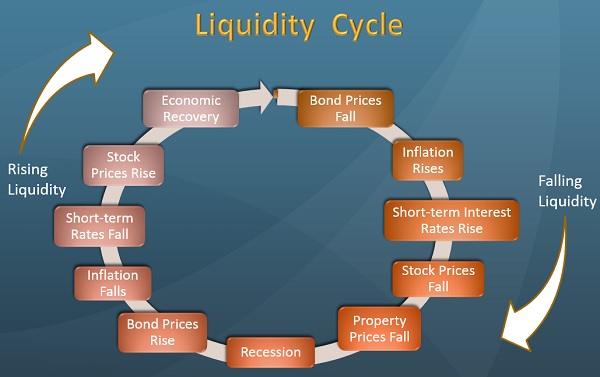
In some of our webinars, we have talked about the importance of the liquidity cycle in understanding how the broader economy, stocks, and bond prices interrelate. The cycle metaphor isn’t always a perfect analogue for what we see in the economy, as recovery and growth can often occur in fits and starts rather than a smooth circular cycle. However, the basic idea still holds.
During the boom part of a cycle, business is generally good. Profits are rising. Managers are optimistic. As a company hires additional workers or expands into lower margin endeavors, costs can rise, or new investments can end up going bad. One company failing will not affect the whole market. However, when a cluster of them fail together, it can begin the “bust” part of the economic cycle. This clustering of failures can occur for a variety of different reasons, from changes in monetary or fiscal policy, to excessive investment or overextension.
As the economy pulls back, capital flows out “riskier” equity investments into “safer” instruments like government bonds or cash. A combination of falling profits and deteriorating financial ratios cause businesses to start laying off people. Which in-turn reduces consumer spending exasperating the downturn.
Only after the economy has worked off the excess (workers have found new jobs in new fields or acquired new labor skills and businesses have regrouped or identified new opportunities), can we can start to see the recovery. And the cycle starts again as investors and money managers regain confidence and start looking for ways to put their money to work.
These booms and busts can be localized within an industry or sector, or they can play out on a national and international stage. The particular causes and effects are different in each scenario, but the overall cycle has similar characteristics.
These cycles are important to our ETF models because the longer-term growth or capital movement into these areas is precisely what the models are trying to pick up on, whether it is capital movement into different sectors, countries, commodities, or financial instruments.
Next week we will look at a few real world examples of this phenomenon to better understand what affects the cycles and how they play out.
The Current Condition of the Model
There were no position changes this week. Our three positions are FXI, EWH, and EWJ. Both models are in all three positions.
Stay tuned to daily updates for any position changes.
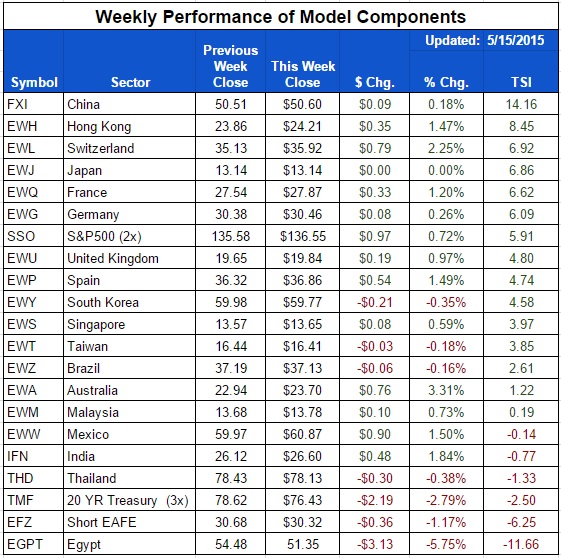
Here is a summary of the weekly performance of all the ETFs that the strategy monitors.
Best wishes for your trading,
James Kimball