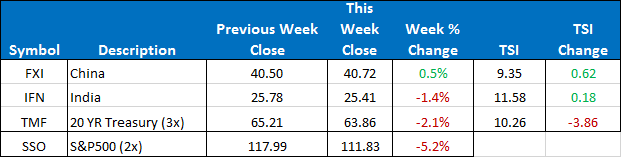
This week we made one position change in the ETF Country model. On Friday, we sold out of SSO and entered FXI. Our current three positions are FXI, TMF, and IFN. For those trading the “Stops & Targets,” TMF is only 2/3rd’s of a position as it reached a target two weeks ago.
The MSCI World Index closed the week down -2.51%. The ETF Country Plus model ended the week down -2.49%. The ETF Country Plus Strategy is up +16.17% year-to-date compared to its benchmark, the MSCI World Index, which is now up +2.42% year-to-date.
This Week’s Strategy Lesson: Guidelines for Constructing a Portfolio
(Part 2)

Last week we began a short series on common guidelines and principles for building your own customized portfolio. This is very important because a well-designed portfolio should have several working pieces that each focus on different objectives but together they accomplish your main growth and risk level goals.
In the first part of this series, we began by discussing the importance of having a long-term perspective in regards to portfolio planning. We want to have a design and composition philosophy that will allow us to weather many market conditions and we need the personal commitment and discipline to stick with the plan that we know will get us there.
The next step is:
2) Determine the Appropriate Asset Allocation
There are two main components to this question: What is right for you, and what is right for the current market conditions.
What is Right for You
Every person is at a different point in their life, their career, and their financial wellbeing. A young career minded person who is only now starting to save will have vastly different objectives than a seasoned career veteran who might be looking to preserve their savings or generate income. But even these are only modestly useful stereotypes, as the spread of financial situations is wider than ever these days.
On a basic level, it is important to determine your overall level of risk. Do you want to be conservative or more aggressive with your portfolio? Do you have expectations that you will need to tap into your portfolio for living expenses in the near future? How close (or far) away are you from funding your retirement needs? How would you react to various drawdowns in your accounts? All of these questions and others can help you determine your comfort and risk level.
Once you have a good idea of how much risk you are willing to take, you can use both asset selection and position sizing as tools in your toolkit to help your portfolio to reflect that overall level.
Putting a small amount of your portfolio in riskier, higher volatility instruments can still result in a conservative portfolio if it is balanced with lower volatility instruments in the rest of your portfolio.
Likewise, some “riskier” investments might in fact be contrarian or counter-cyclical investments that have low or negative correlation to the rest of the market. These instruments, while on the face of it might appear to increase your risk, however when taken as a whole with the rest of your portfolio might actually reduce risk and volatility because of the way they interact with other parts of your portfolio.
What is Right for the Current Market Conditions
The ETF strategies are not “traditional” asset allocation strategies in the sense that you would put a fixed percent of your assets in U.S. equities, a fixed percent in bonds, and a fixed percent in international equities, but in many ways, they meet this criteria. If you have both the Sector and Country models, then you have many of those categories in our list of potential ETFs.
In a traditional fund, a portfolio manager might increase or decrease their holdings in bonds based on their view of that market. Whereas in the ETF models, the TSI ranking acts as the portfolio manager, constantly searching and evaluating the universe of ETFs, and based on the selection criteria setup beforehand, it attempts to get us in and out of the areas of the market that have the best chance for growth.
Traditional funds/portfolios are also limited during downturns in the market because they are long only and can’t take short positions on the market. The ETF models have built several short sensitive instruments into their investible universe.
During quick downturns, the Trend Strength Indicator typically won’t change enough to put us into the short positions, but during a downturn with some continuation, you can expect to see the short/contrarian ETFs begin to enter our holdings.
Stay tuned next week as we discuss developing an investment strategy to meet your portfolio goals.
The Current Condition of the Model
For the country model, we are in FXI, IFN, and TMF. SSO has basically been on the verge of being replaced for a couple weeks and the recent selloff in the broader markets finally forced that change. We ended up selling out of the position just above breakeven (0.68% profit).
FXI has been very strong lately. We entered after a three day correction and it outperformed the SPY on a relative basis. We will have to see how this position plays out.
Stay tuned to daily updates should this switch trigger.
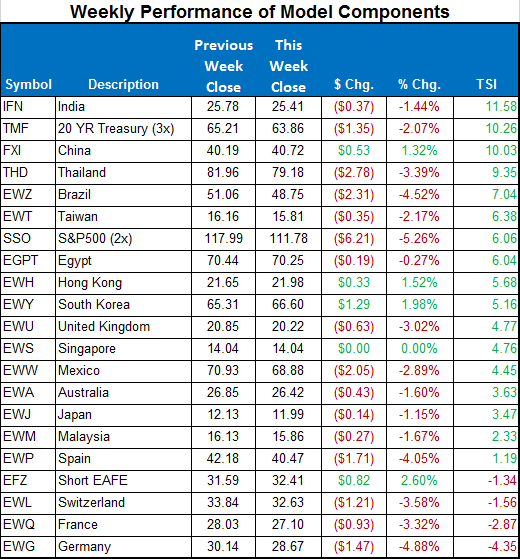
Here is a summary of the weekly performance of all the ETFs that the strategy monitors:
Best wishes for your trading,
James Kimball
Trader & Analyst
MarketGauge