November 30, 2014
Weekly Market Outlook
By Mish Schneider
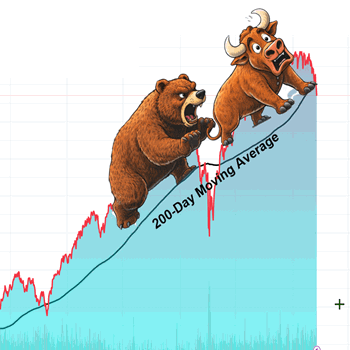
The Bull in this market is pulling a lot of dead weight!
 According to Barron’s this week, “less than 15% of the money managers who actively select stocks are ahead of their benchmarks” this year.
Well, I’m not surprised. 2014 has been a year in which it seems like everything normal has been wrong, and as a result, the performance of individual stocks is (by my calculations) is 8 times more bifurcated than normal!
For example...
And it’s clear that the market can’t make sense of it all.
On Friday the NYSE registered 331 new highs and 164 new lows. For those of you who don’t look at these numbers all that closely, this is quite remarkable on a number of levels - and NOT particularly bullish!
First some perspective… since to 1997 there have only been 7 other days in which there more than 150 new lows at the same time that the market had over 300 new highs. Looked at a slightly different way, since 1997 when there have been between 300 and 360 new highs (roughly 10% more or less than Friday’s number), the average number of new lows is 21. So by that measure, the market is 8 times more bifurcated than normal!
Four of them all happened within the same week – Feb 14-17, 2011. Then again on July 11th 2011, and other two days occurred earlier that year on the 13th and 14th of Jan. At this time the market was about a year and half from its historic 2009 lows so such a large number of polar opposite stock conditions would understandably make a little more sense considering the market could have still been considered “recovering”.
However, a “recovering” market may explain the condition, but it doesn’t dismiss the market risk it illuminates.
A quick look at the charts reveals that the string of 4 days in February 2011 marked the beginning of the end of very strong 16 month run. Then the occurrence on July 11th 2011 rang the final bell for the bulls as it occurred less than 2 weeks prior to the beginning of the worst correction the market has the experienced since 2009 lows (including last month’s unsettling drop).
I don’t want to suggest this is a perfect indication of a market top, but this bifurcation should not happen at historic highs in the Dow, S&P 500 and Nasdaq indexes.
There are only a few ways this situation can resolve itself. First, the market’s strength could continue and the number of stocks hitting new 52 week lows could return to a more normal level. If the market continues higher you’ll want to make sure this happens!
The second outcome is that the leading stocks will falter and the market will stop going up, or worse, sell off dramatically. This will happen if the leading industry groups and sectors begin to decline without new sectors taking over the leadership role.
Either way, several trading trends have been clear this year.
So with all that in mind, this week’s video will reveal our new and improved free market analysis service called “Little Big View”. It’s located under the “Resources” area of our main menu.
This is simple way for you to track the health of the market based on its volume accumulation/distribution, trending ETFs, market breadth measures and more!

Every week you'll gain actionable insight with: