August 2, 2026
Weekly Market Outlook
By Geoff Bysshe

This week's article is a summary of several of the key themes I discuss in this week's Market Outlook video. Rather than reviewing every chart from the presentation, I want to focus on the developments I believe will have the greatest influence on where the market goes over the next several weeks.
The stock market has shown impressive resilience.
Despite rising geopolitical tensions, investors have largely looked past inflation concerns, choosing instead to focus on artificial intelligence, improving corporate earnings, and the expectation that large technology companies will continue driving the market higher.
But the backdrop is changing.
Short-term Treasury notes rallied sharply last week, pushing their yields lower. At the same time, longer-term bonds moved in the opposite direction, sending 10-year and 30-year yields higher.
That combination created a steeper yield curve.
The move suggests the market is less confident in the Federal Reserve's ability to take decisive action to fight inflation. Investors appear increasingly concerned that inflation may remain elevated for longer, leaving the Fed with fewer attractive policy options.
The market wasn't the only one disappointed by last week's press conference. The New York Times immediately reported that Chair Warsh is considering reducing the number of Fed meetings from eight to four per year.
We’ve had 8 meetings annually since Paul Volker began this in 1981!
Warsh is changing how the Fed will measure the economy and reducing the feedback the Fed will offer on its thinking. It’s not surprising that the bond market isn’t happy, and that means higher long-term rates.
Higher long-term rates matter because they increase the cost of capital, pressure valuations, and reduce the present value of future earnings. That is particularly important for highly valued growth stocks whose valuations depend heavily on profits expected many years into the future.
Higher rates can also weigh on housing, commercial real estate, capital-intensive businesses, and smaller companies that depend more heavily on borrowing.
This doesn't mean the bull market is over.
But it does mean investors may become less willing to pay any price for growth.
The market has handled this shift surprisingly well so far.
The question is whether it can continue to do so.
One of the themes I discussed in this week's video is that the major indexes continue to mask some important internal differences.
The S&P 500 continues to hold up well.
However, momentum and leadership have become increasingly selective.
Some of the strongest trends continue to work, while many other stocks are struggling to participate. In several cases, the indexes have held near their highs while momentum has failed to confirm the strength of the price trend. This is most notable in VTV, where momentum has continued to weaken despite price remaining relatively resilient.
This type of momentum divergence deserves attention because price can remain strong for a period of time even as the underlying trend begins to weaken.
The bearish signal becomes more important if price eventually follows momentum lower, breaking through key levels like the 50- and 200-day moving averages.
This is the problem SMH is struggling with right now.
For now, SPY and its equal-weight counterpart RSP remain constructive, but the market needs broader participation and stronger momentum confirmation to make the rally more durable.
That makes this earnings season particularly important.
The headlines will focus on whether Meta, Microsoft, Amazon, and Apple beat earnings estimates.
That is the wrong question.
The more important question is:
How do investors react after the numbers are released?
Wall Street has a way of driving expectations to extremes before eventually leaving investors disappointed.
Over the past several quarters, companies have consistently exceeded earnings estimates while analysts have continued raising future expectations. That combination has helped fuel one of the strongest earnings environments of this bull market.
Eventually, however, expectations become difficult to exceed.
Markets usually top before earnings suddenly become bad.
The first sign of trouble is when investors decide good earnings are no longer good enough.
If stocks begin selling despite reporting strong results, the narrative can shift quickly from "better than expected" to "peak earnings," "as good as it gets," or "expectations were too high."
That shift in psychology often matters far more than the earnings report itself.
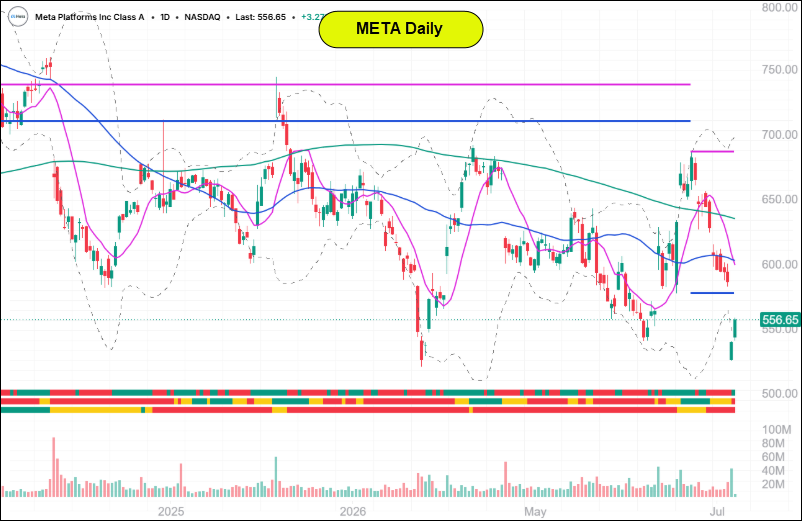
Meta's chart was weak before the earnings report, and the market's reaction made it clear that investors are no longer willing to blindly support aggressive AI and infrastructure spending without convincing evidence that it will generate a meaningful return on investment.
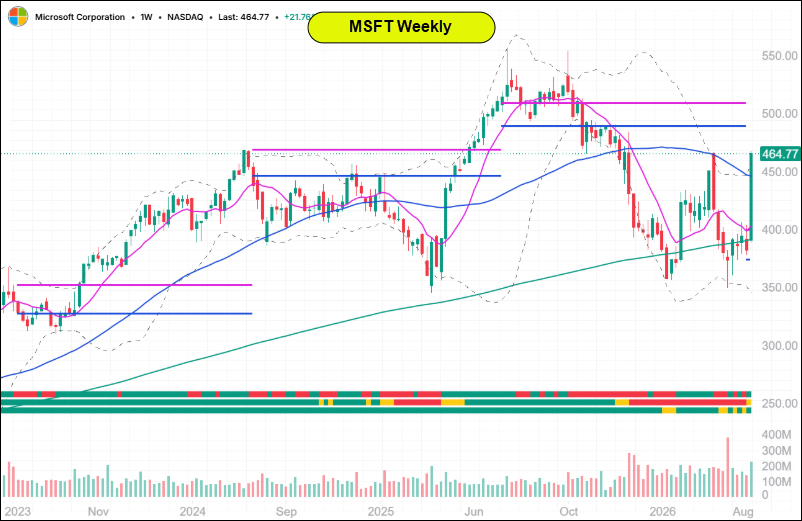
Microsoft remains one of the highest-quality businesses in the market with leading positions in both cloud computing and AI.
Unfortunately, its rollout of Copilot has been an embarrassment. The product simply hasn't lived up to Microsoft's capabilities or investors' expectations.
As you can see from the chart above, the bulls have been supporting it at its 200-week moving average (green).
Fortunately, the company reported better-than-expected cloud growth, meaningful improvements in Copilot, and no increase in capital spending.
If Microsoft can continue improving Copilot while maintaining its capital discipline, investors could quickly regain confidence. The reaction from the key price level bodes well for the stock.
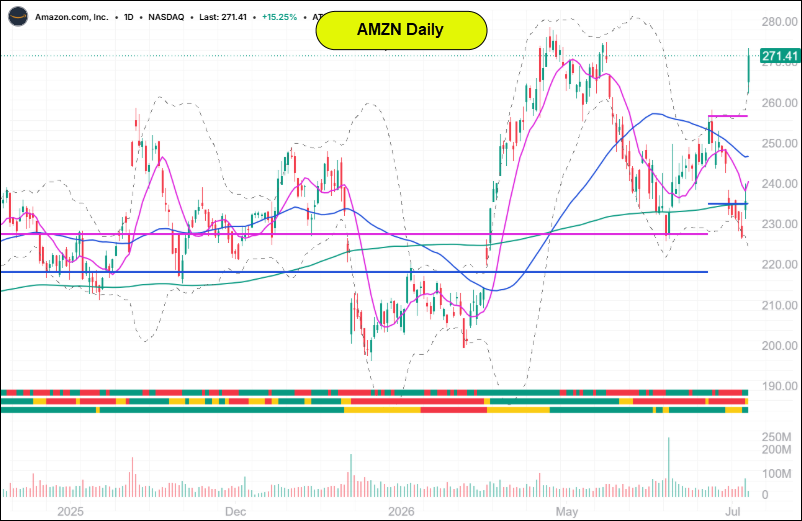
Amazon's earnings delivered a little of both—continued spending alongside a genuine growth surprise. As demonstrated by several gaps and no real trend, AMZN has struggled over the last 18 months.
If it can hold the breakout over $260, the PRIME analysis ribbon beneath the chart will turn the intermediate-term measure from neutral to bullish (from yellow to green), and for the first time since it’s run higher in early 2026, all time frames will be aligned.
This is one to use the July Range high as your inflection point.
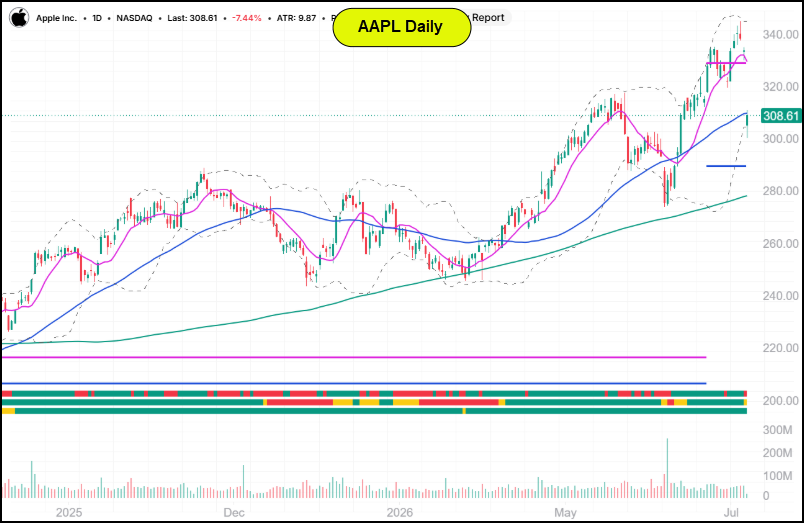
Apple was hit on lower projected growth, concerns about margin pressure, and higher input costs. It also continues to trade at a historically rich valuation.
Unlike its peers, however, Apple isn't trying to win the AI infrastructure spending race—it's largely letting its AI partner, Google, make those investments. Smart? We’ll soon see.
The 10% decline sounds dramatic, but technically the stock has simply pulled back to its 50-day moving average within an otherwise healthy uptrend.
Let the market tell you what comes next. Over the 50-day is bullish; under, wait and see.
In short, the dispersion among the big technology companies' strategies—and the market's reactions to them—is becoming increasingly wide.
The media often portrays AI as one giant trade.
The charts tell a different story.
There are—and will continue to be—many different paths through the AI landscape.
The bulls still have several important advantages.
Corporate earnings remain strong, the largest technology companies continue adapting to protect cash flow, and the major indexes remain in constructive long-term trends.
However, the market is now being asked to overcome higher long-term interest rates, selective momentum, and extremely high expectations for its largest companies.
Those conditions reduce the market's margin for error.
Markets rarely change because the facts suddenly change.
They change because investors begin interpreting the same facts differently.
Over the next several weeks, investors should pay close attention to three things:
If the market rewards strong earnings, the bull market can continue climbing despite higher interest rates.
If good earnings begin producing disappointing stock reactions, investors should pay attention.
That's often how market narratives begin to change.
 |
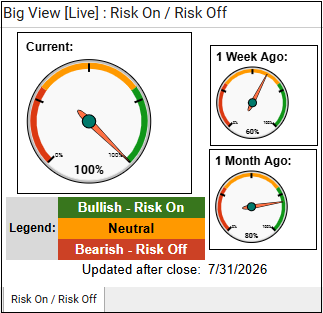 Every week we review the big picture of the market's technical condition as seen through the lens of our Big View data charts. Every week we review the big picture of the market's technical condition as seen through the lens of our Big View data charts.
The bullets provide a quick summary organized by conditions we see as being risk-on, risk-off, or neutral. The video analysis dives deeper. |

Every week you'll gain actionable insight with: