May 31, 2026
Weekly Market Outlook
By Geoff Bysshe
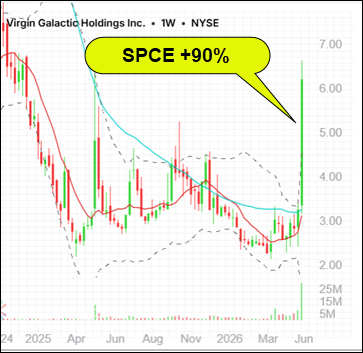
Last week, the space industry was exploding — literally and figuratively.
Virgin Galactic (SPCE) rallied about 90% for the week after investors reacted to renewed test flights with a successful launch.
This is exactly the type of impact a “tipping point of visibility” can have, which is what I wrote about in last week’s Market Outlook, "The Most Valuable Asset In The SpaceX IPO
Is A Gift That Most Investors Will Ignore."
When Wall Street sees the vision of the future, the conversation changes. Investors stop thinking about the theme as science fiction. FOMO develops, and investors scramble to find exposure to the next best idea.
Blue Origin, on the other hand, suffered a very different kind of headline when one of its rockets exploded on the launch pad.
Investors should expect space stocks to produce spectacular rallies, dramatic setbacks, and emotionally charged headlines. The SpaceX IPO is likely to amplify all three.
It’s a good time to define a framework for following space stocks.
The first mistake investors are likely to make is treating “space stocks” as one category.
They are not.
A launch company, a satellite operator, a defense contractor, a lunar infrastructure company, and a geospatial data company may all be considered space stocks, but they are very different businesses.
They have different customers.
They have different revenue models.
They have different levels of capital intensity.
They have different risk.
They may also respond very differently to the same headline.
For example, a successful commercial spaceflight test may help a stock like Virgin Galactic, but it may not mean much for a company focused on satellite imagery, defense payloads, or secure communications.
That’s why investors need a simple map.
Here’s the framework I’m using to follow the space industry.
The space economy is best understood as a stack.
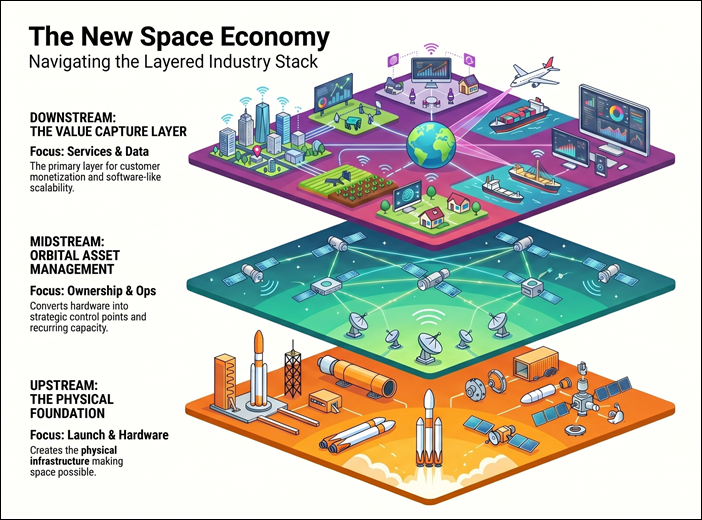
A framework helps investors distinguish between news that may affect the entire space industry and news that may only affect a specific company or layer of the stack.
Upstream companies may benefit from more launches, more satellites, more spacecraft, and more hardware demand. These companies can be exciting, but they can also be capital intensive.
Midstream companies may benefit from owning or operating assets in orbit. These companies can create recurring revenue if they successfully turn orbital infrastructure into usable capacity.
Downstream companies may ultimately capture some of the largest commercial opportunities because they convert space-based infrastructure into services customers already understand: communications, broadband, Earth observation, defense intelligence, data, analytics, and software.
In short, the space economy is not just rockets.
Rockets may create the headlines, but the long-term investment opportunity is much broader.
Below is a list of publicly traded companies with some direct interest in the space economy. This is not an exhaustive list. It’s a focused list.
Some companies are primarily focused on space. Others are large aerospace, defense, industrial, or software companies with partial space exposure.
| Ticker | Company Name | Space Focus | Layer | Group |
|---|---|---|---|---|
| RKLB | Rocket Lab | Primary | Upstream | Launch and transportation |
| ASTR | Astra Space | Primary | Upstream | Launch and transportation |
| SPCE | Virgin Galactic | Primary | Upstream; Midstream; Downstream | Launch and transportation; In-orbit services, logistics, and station infrastructure; Space tourism, human spaceflight, and commercial habitats |
| FLY | Firefly Aerospace | Primary | Upstream | Launch and transportation |
| RDW | Redwire | Primary | Upstream; Midstream | Spacecraft and satellite manufacturing; In-orbit services, logistics, and station infrastructure |
| LUNR | Intuitive Machines | Primary | Upstream | Spacecraft and satellite manufacturing |
| VOYG | Voyager Technologies | Primary | Upstream; Midstream | Spacecraft and satellite manufacturing; In-orbit services, logistics, and station infrastructure |
| AIR | Airbus Defence and Space | Primary | Upstream | Spacecraft and satellite manufacturing |
| OHB | OHB SE | Primary | Upstream | Spacecraft and satellite manufacturing |
| MDA | MDA Space | Primary | Upstream | Spacecraft and satellite manufacturing |
| SIDU | Sidus Space | Primary | Upstream | Components, payloads, and ground systems |
| IRDM | Iridium | Primary | Midstream; Downstream | Satellite operators and constellation owners; Satellite communications and connectivity |
| GSAT | Globalstar | Primary | Midstream; Downstream | Satellite operators and constellation owners; Satellite communications and connectivity |
| SATS | EchoStar | Primary | Midstream; Downstream | Satellite operators and constellation owners; Satellite communications and connectivity |
| VSAT | Viasat | Primary | Midstream; Downstream | Satellite operators and constellation owners; Satellite communications and connectivity |
| ASTS | AST SpaceMobile | Primary | Midstream; Downstream | Satellite operators and constellation owners; Satellite communications and connectivity |
| SPIR | Spire Global | Primary | Midstream; Downstream | Satellite operators and constellation owners; Earth observation, sensing, and geospatial intelligence; Data, software, and analytics layers |
| PL | Planet Labs | Primary | Midstream; Downstream | Satellite operators and constellation owners; Earth observation, sensing, and geospatial intelligence; Data, software, and analytics layers |
| BKSY | BlackSky | Primary | Midstream; Downstream | Satellite operators and constellation owners; Earth observation, sensing, and geospatial intelligence; Data, software, and analytics layers |
| SATL | Satellogic | Primary | Midstream; Downstream | Satellite operators and constellation owners; Earth observation, sensing, and geospatial intelligence |
| ETL | Eutelsat/OneWeb | Primary | Midstream; Downstream | Satellite operators and constellation owners; Satellite communications and connectivity |
| SES | SES | Primary | Midstream; Downstream | Satellite operators and constellation owners; Satellite communications and connectivity |
| TSAT | Telesat | Primary | Midstream | Satellite operators and constellation owners |
| KTOS | Kratos Defense | Partial | Upstream; Downstream | Launch and transportation; Defense-space systems and sovereign demand |
| BA | Boeing | Partial | Upstream; Downstream | Spacecraft and satellite manufacturing; Defense-space systems and sovereign demand; Space tourism, human spaceflight, and commercial habitats |
| LMT | Lockheed Martin | Partial | Upstream; Downstream | Spacecraft and satellite manufacturing; Defense-space systems and sovereign demand |
| NOC | Northrop Grumman | Partial | Upstream; Downstream | Spacecraft and satellite manufacturing; Defense-space systems and sovereign demand |
| LHX | L3Harris | Partial | Upstream; Downstream | Spacecraft and satellite manufacturing; Defense-space systems and sovereign demand |
| LDOS | Leidos | Partial | Upstream; Downstream | Spacecraft and satellite manufacturing; Defense-space systems and sovereign demand |
| HON | Honeywell | Partial | Upstream | Spacecraft and satellite manufacturing |
| GE | GE Aerospace | Partial | Upstream | Spacecraft and satellite manufacturing |
| MRCY | Mercury Systems | Partial | Upstream | Components, payloads, and ground systems |
| TDY | Teledyne Technologies | Partial | Upstream; Downstream | Components, payloads, and ground systems; Earth observation, sensing, and geospatial intelligence |
| ATRO | Astronics | Partial | Upstream | Components, payloads, and ground systems |
| KRMN | Karman Holdings | Partial | Upstream | Components, payloads, and ground systems |
| MYNA | Mynaric | Partial | Upstream | Components, payloads, and ground systems |
| TDG | TransDigm | Partial | Upstream | Components, payloads, and ground systems |
| HWM | Howmet Aerospace | Partial | Upstream | Components, payloads, and ground systems |
| RTX | RTX | Partial | Downstream | Defense-space systems and sovereign demand |
| GD | General Dynamics | Partial | Downstream | Defense-space systems and sovereign demand |
| PLTR | Palantir | Partial | Downstream | Defense-space systems and sovereign demand; Data, software, and analytics layers |
For this article, I’m going to focus primarily on the companies whose business exposure is most directly tied to space, as they are likely to be more sensitive to investor enthusiasm and volatility as the SpaceX IPO rolls out.
Great stock trends are a function of many factors, and nowhere is this more valuable to understand than in an emerging industry like space.
This is where the MarketGauge PRIME framework becomes useful.
PRIME evaluates five forces that help determine the health and potential of a stock’s trend:
These factors cover investor sentiment, company fundamentals, and the technical condition of the chart.
A good company is not always a good stock, and vice versa.
A company can be in the right industry and still be the wrong stock to buy today.
A company can have an exciting story and still have a weak chart.
A company can rally sharply and still lack durability.
The best trends begin and continue when at least 3 of the 5 PRIME factors are aligned.
Friday was a down day for the group.
That’s not surprising after the size of some of the moves earlier in the week.
The important point is that Friday’s weakness did not change the bigger message from the PRIME rankings.
As you can see by the three columns in the table below that display the short-, intermediate-, and long-term trend rankings, the primary space stocks remain broadly constructive.
On a scale of 1 to 5, most stocks have rankings above 3, indicating a bullish technical condition.
More specifically, most are in bullish price phases. Several remain relatively close to their 52-week highs. And the best-ranked names continue to show strong PRIME alignment across multiple time frames.
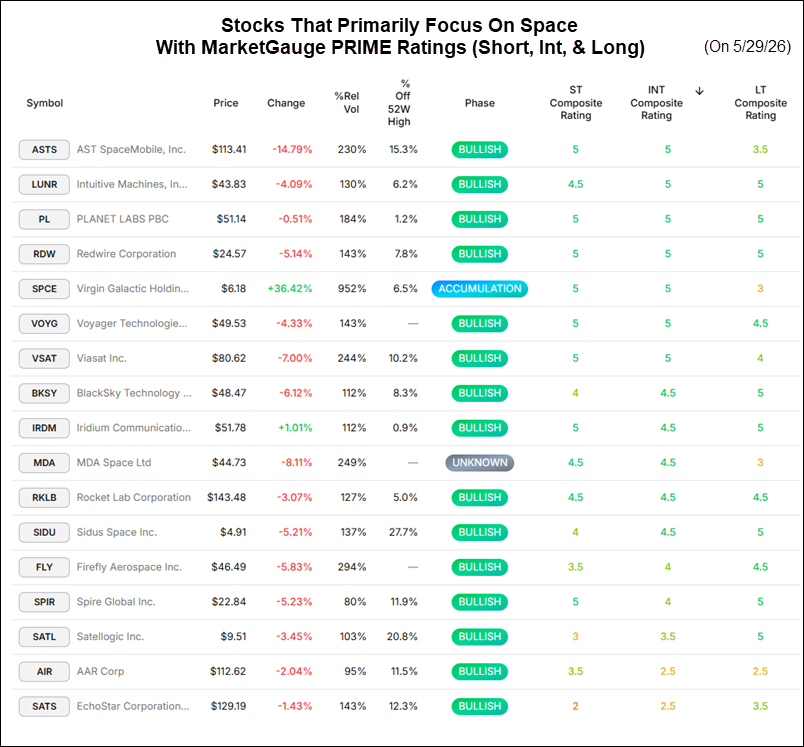
Without a framework, a 90% weekly move in SPCE can make the whole group feel exciting.
A rocket explosion at Blue Origin can make the whole group feel dangerous.
Both reactions are understandable.
Neither is enough.
The better questions are:
Which stocks are already showing leadership?
Which stocks are improving?
Which stocks are extended?
Which stocks are still speculative?
Which stocks should be watched, but not chased?
That’s where the PRIME ranking provides a more useful view.
I’m not going to review every stock in the table here.
That would turn this article into a directory.
Instead, I want to highlight a few names from the ranking table that deserve a closer look based on their current PRIME condition.
These are not intended to be the only space stocks worth following. They are timely examples of how the framework works.
Spire Global is a space-based data, analytics, and space services company. It operates a proprietary constellation of low Earth orbit nanosatellites, known as LEMUR, to collect environmental and other data from space.
This makes SPIR one of the cleaner public ways to follow the data and services side of the space economy.
The company is not profitable yet, but it has improved earnings and sales in four of the last five years, and both are expected to accelerate going forward.
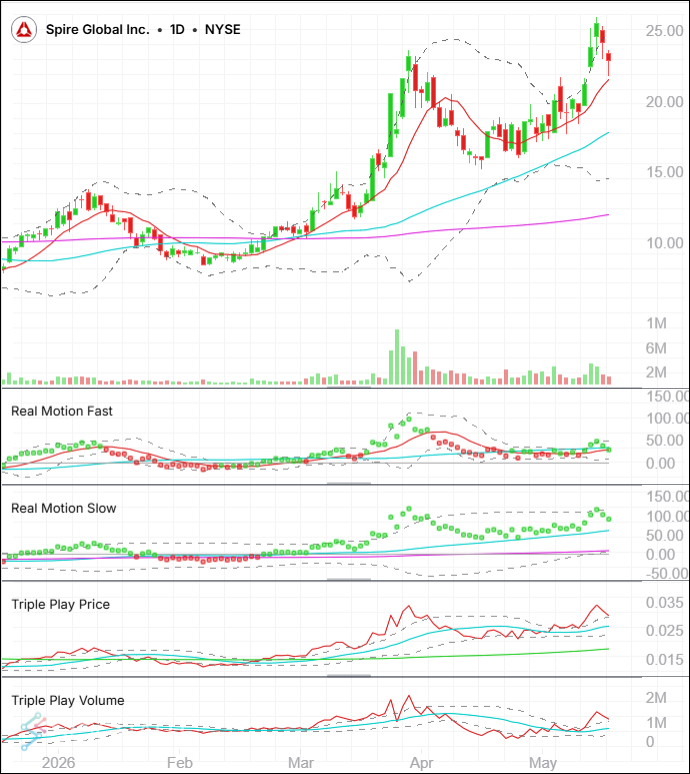
Technically, the $20–$21 area has been a major resistance zone for the stock in 2024, 2025, and earlier this year. Early last week, the stock appeared to break out with a close above $25. However, weakness in the space group pulled it back to a Friday close of $22.84.
That leaves SPIR in an interesting position.
A pullback that holds near $20 would suggest prior resistance is becoming support. A move back above its April high near $23.50 would suggest momentum is rebuilding.
This is the kind of setup I like to watch closely because the story is strong, the PRIME condition is constructive, and the risk levels are becoming more defined.
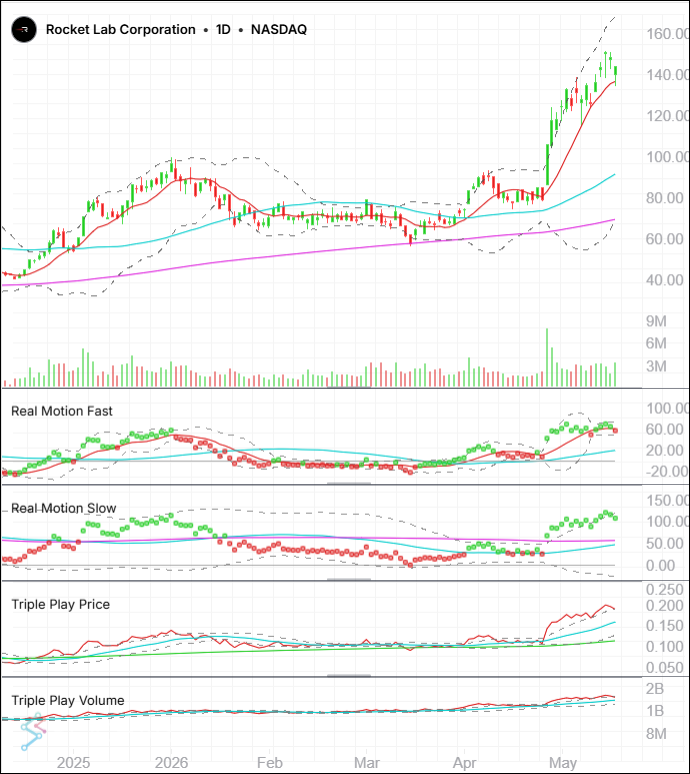
Rocket Lab is one of the most important public pure-play space companies to follow. The company provides launch services and space systems solutions for commercial, government, and defense customers.
If you are watching the public space-stock universe, you should be watching Rocket Lab.
It has grown sales for the last four years and expects both sales growth and earnings growth to accelerate into 2027. It also expects to become profitable in 2027.
Technically, RKLB has had a parabolic move.
The stock has reached levels on our Real Motion momentum indicator that often mark short-term exhaustion. This does not mean the long-term trend is over, but it does suggest the stock may need time to consolidate.
If the pullback holds near its 10-day moving average and recent support area, nimble traders may still have a defined-risk way to participate in the current up move.
If that support fails, however, I would rather wait for a deeper reset than chase the stock after a vertical advance.
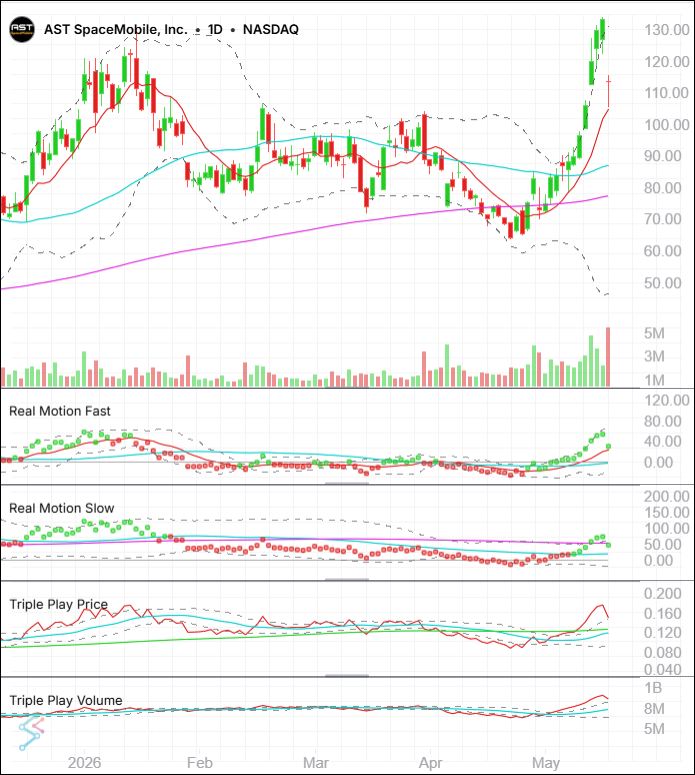
AST SpaceMobile is developing a space-based cellular broadband network designed to connect directly to standard, unmodified smartphones.
The company’s goal is simple and ambitious: eliminate cellular dead zones by providing global broadband coverage without specialized equipment.
On Friday, ASTS was down sharply after Blue Origin’s failed launch because ASTS uses Blue Origin to launch its satellites. Deutsche Bank also cut its rating from Buy to Hold and reduced its price target as a result, expecting earnings to be pushed back.
The news was undeniably bad for ASTS.
However, the strength of its PRIME rating indicators and the fact that the number of funds listed as owners reportedly jumped from 473 to 805 last quarter suggest there has been significant institutional demand for the stock.
Technically, ASTS bottomed around $105 on Friday, which is above an area that offers a lot of support. It then closed in the top half of its daily range.
If ASTS can climb back to a close above $122, which was its high close prior to last week, it would suggest investors are looking past the short-term launch schedule issues.
If it cannot, the failed launch may continue to weigh on the stock in the short term despite the strength of the longer-term story.
This is exactly the kind of situation where PRIME is useful.
The story is compelling. The news is volatile. The chart gives us a way to judge whether investors are still supporting the stock.
The SpaceX IPO has already become an event that makes space investing feel obvious to the broader market.
But by the time something feels obvious, the first wave of opportunity may already be underway.
The public space-stock universe is already taking shape. A savvy investor will find a simple framework to understand the industries sectors and groups - launch companies, infrastructure companies, satellite operators, communications providers, geospatial intelligence companies, defense-space contractors, and data/software platforms.
Some are pure plays.
Some are partial exposures.
Some are leaders.
Some are speculation.
Some are not ready yet.
The SpaceX IPO will bring more attention, more volatility, more headlines, and more capital into the theme.
That is good news for you if you’re prepared.
It will be confusing and dangerous for investors without preparation and discipline.
The space-stock group is no longer just a speculative idea, and, as I outlined in last week’s Market Outlook, the opportunities are likely even bigger than those we’re seeing in the AI bull market.
If you'd like access to the MarketGauge indicators, strategies, automated trading models, and more, contact us.
Best wishes for your trading,
Geoff Bysshe
Co-Founder
(Connect on LinkedIn)
 |
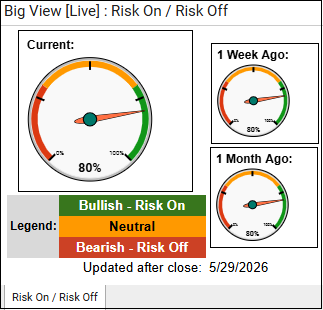 Every week we review the big picture of the market's technical condition as seen through the lens of our Big View data charts. Every week we review the big picture of the market's technical condition as seen through the lens of our Big View data charts.
The bullets provide a quick summary organized by conditions we see as being risk-on, risk-off, or neutral. The video analysis dives deeper. |
Summary: Markets continued their powerful rally, marking nine straight weeks of gains with leadership from technology, semiconductors, and other risk-on sectors, while volatility remained subdued and seasonal trends stayed favorable. However, beneath the surface, market participation and internals remain only modestly improved, with weak retail action, mixed volume, and shaky breadth suggesting the advance may still be somewhat narrow and vulnerable to pullbacks.
Risk On
Neutral
The market remains in a strong bullish trend with broad risk-on characteristics, supportive seasonal trends, and volatility continuing to compress. Given the persistence of the move and the lack of overbought real motion readings, the primary strategy should remain tilted toward staying invested while tactically managing signs of weakening breadth and narrow participation.
Maintain an overweight allocation toward leadership areas including technology, semiconductors, and selective growth exposure, as these continue to demonstrate the strongest momentum and relative strength. Clean energy is also emerging as a short-term leadership group and may offer tactical opportunities on consolidations or pullbacks. Emerging and developed international markets continue to act well and can remain part of diversified equity exposure.
At the same time, caution is warranted beneath the surface. Market internals remain only moderately supportive, participation remains thin, and Granny Retail slipping back into a warning phase suggests the rally is not yet fully broad-based. Because of this, avoid excessive leverage or aggressive chasing after extended upside moves, particularly in names that are already significantly above key moving averages.
Use pullbacks into the 10-day or 20-day moving averages as preferred entry opportunities rather than chasing strength after large gap-up moves. Existing profitable positions can continue to trail stops higher underneath recent swing lows or intermediate-term moving averages to protect gains while allowing room for trend continuation.
Continue to underweight traditionally defensive sectors such as utilities, staples, and potentially energy until relative strength improves meaningfully. The weakness in soft commodities and oil, combined with stabilizing rates, may indicate easing inflation pressures and could become increasingly supportive for longer-duration growth assets if bond strength continues.
Watch several key warning signs closely:
If breadth meaningfully improves and rates continue stabilizing, the current rally could broaden and support another leg higher. Conversely, if leadership narrows further while internals weaken, be prepared for a rotational correction or consolidation phase despite the bullish index trends.

Every week you'll gain actionable insight with: