The Stocks of Barron’s “Top CEOs”
Get Ranked by PRIME Analysis
This week Barron’s released its ranking of the country's “Top CEOs.”
History has shown that a great CEO isn’t always the best reason to buy a stock, but it is a strong reason to consider one, especially in today’s environment with such technological, political, and economic volatility.
The Best Stocks To Buy Now
A company with a great CEO offers three distinct active investment opportunities we’d describe as the “best stocks to buy now.” For example,
- Stocks that are clearly headed higher and not looking back
- Stocks that have a strong trend but have been knocked down recently
- Stocks that have been beaten down, and to be bullish, you need to believe in something other than the price trend.
There are different reasons to call each of those situations “the best stocks to buy now”, and we’ll cover that shortly.
The “E” in PRIME Is The Foundation of Big Stock Market Winners
First, it’s important to know how our list of “top CEOs” was determined, because in this case, this criterion is the “E” in the PRIME analysis we’re using for selecting great active investment opportunities.
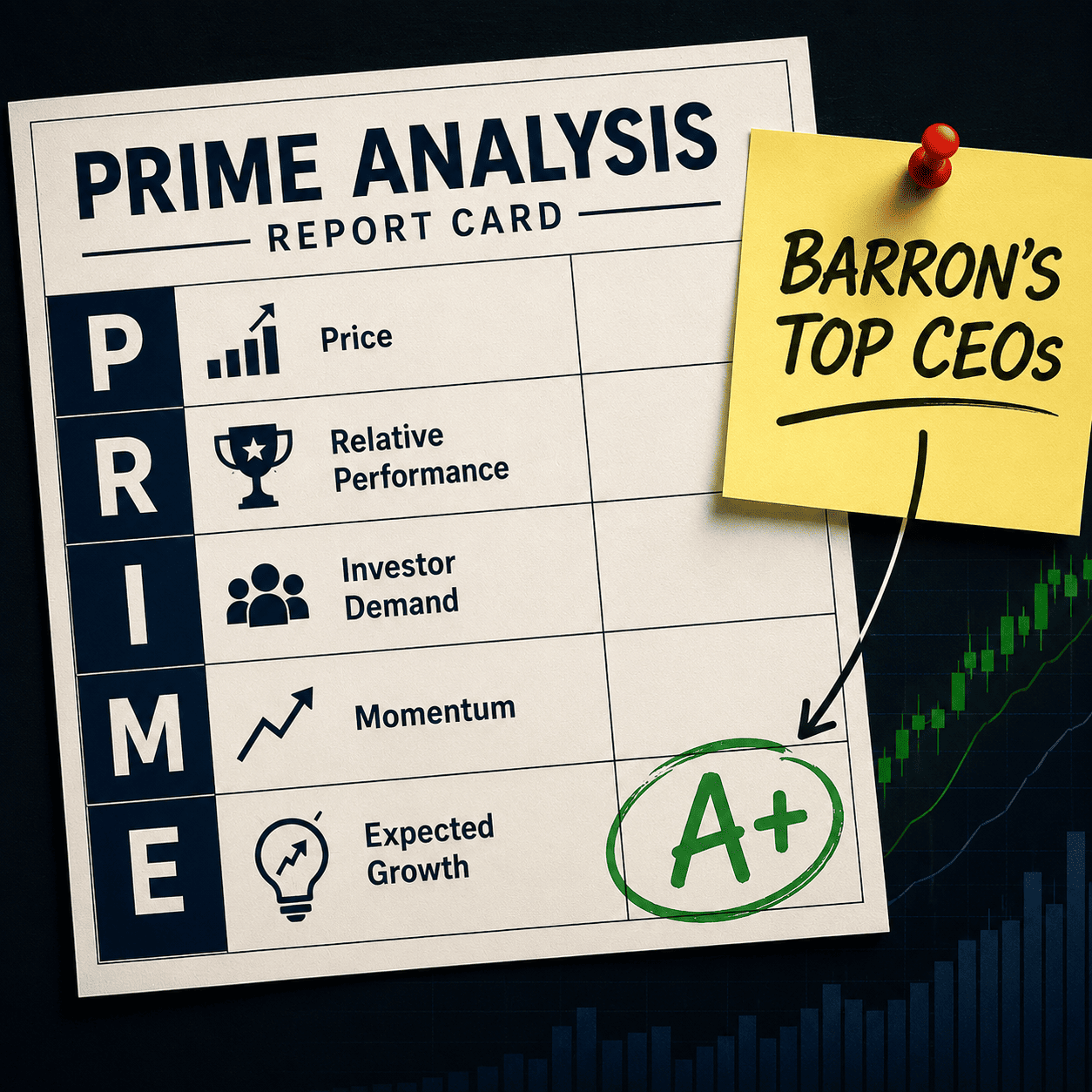
PRIME is an acronym that stands for a 5-criteria (P + R + I + M + E) framework that determines both WHICH stocks are great opportunities and WHEN the opportunity is likely to blossom.
E in PRIME represents the existence of a bullish expected growth story. “E” is the measure of a fundamental reason bullish investors believe the company will experience growth worth betting on.
A common metric of a high quality “E” is strong earnings growth. Year over year, quarter over quarter, rising estimates, etc. are easy to evaluate metrics that provide a solid foundation for building and maintaining the investor demand that drives stock prices higher.
However, the CEO can also be the reason to expect great growth before it shows up in the income statement and analyst estimates. For example,
- Shortly after Li-Bu Tan took over at Intel, it began a move that has exceed 500%
- Larry Culp at GE spun out GE Vernova (GEV) in 2024, which has returned about 1,000%, while GE has doubled over the same period
- Jane Fraser is the 13th CEO to try to turn around Citigroup (C), according to analyst Mike Mayo, and she’s the first to succeed. It’s still rising from the ashes of the Great Recession, but under her leadership, it has performed the industry's gold standard, JPM, since the 2020 COVID low.
CEO’s aren’t just good indicators of opportunities from turnarounds or spin-offs. Michael Dell brilliantly repositioned what Wall Street viewed as a PC maker into a dominant force in data centers, making it one of the best-performing stocks this year.
The Barron’s Top CEOs list is a great place to find a company that could qualify as having a great “E” value in PRIME because their criteria is not the stock price. In Barron’s words, “…which companies have shown the most skill in maximizing the moment, while preparing for what’s next? This was one dominant theme in selecting 25 names for our annual Top CEOs list.”
Great Companies & CEOs Don’t Always Equal Great Stocks
A company with great leadership and even great fundamentals isn’t always a timely trade or investment. That’s where PRIME analysis comes in. PRIME is your way to measure what investors are doing with the stock.
A strong “E” and investor demand as measured by “P + R + I + M” will lead to timely trade with big potential.
As we stated above, this can happen with stocks in several different conditions:
- Stocks that are clearly headed higher and not looking back
- Stocks that have a strong trend but have been knocked down recently
- Stocks that have been beaten down, and to be bullish, you need to believe in something other than the price trend.
**The rest of the commentary will be posted later tonight.
 |
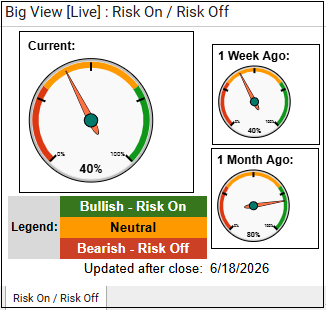 Every week we review the big picture of the market's technical condition as seen through the lens of our Big View data charts. Every week we review the big picture of the market's technical condition as seen through the lens of our Big View data charts.
The bullets provide a quick summary organized by conditions we see as being risk-on, risk-off, or neutral.
The video analysis dives deeper. |
Summary: Markets continued to lean risk-on as major indexes pushed back toward recent highs, led by NASDAQ strength, improving breadth, strong global equity participation, easing rates, and continued leadership from semiconductors and cyclical sectors. While the overall backdrop remains constructive and seasonally favorable through July, lingering concerns include weak market internals confirmation, elevated defensive leadership from rates and utilities, and mixed signals from commodities, the dollar, and bitcoin. To really confirm the Bull case both the SPY and QQQ need to take out all time highs set late May and early June.
Risk On
- Markets were up, revisiting their recent highs with NASDAQ showing the strongest relative performance and the SPY sitting about 1.8% off its recent high. (+)
- Sectors leaned towards a weak risk-on reading with technology strength in Technology, homebuilders, and industrials, while retail and healthcare were down on the week. (+)
- Asian ex China equities led this week, while energy stocks sold off due to the opening of the Gulf. (+)
- The 52-Week new high new low continues to improve with slopes moving positive in S&P. (+)
- The color charts (moving average of stocks above key moving averages) are showing positive readings in the S&P and IWM, with a bit more neutral reading in QQQ, particularly short-term.(+)
- Volatility closed around the same levels as last week, off its highs but still slightly elevated. A weak risk on reading. (+)
- Growth is lagging and still off its recent highs while value is outperforming and hit new highs this week. Both are in bull phases. The 50-Day Moving Average and lows from last week in Growth remain critical to watch. (+)
- The modern family looks strong with all members in bull phases and semiconductors making new all-time highs. (+)
- Emerging and developed markets look strong with emerging markets putting in a new all-time high on Friday. (+)
- Rates eased across the board even as talk about the new Fed Chairman being a rates hawk. (+)
- Broader Seasonal trends remain quite bullish for equities through the end of July. (+)
Neutral
- Risk gauges remained at 40% with the strength in rates and utilities relative to the SPY. (=)
- Volume patterns on average improved to neutral across the indexes. (=)
- Market internals for both the SPY and QQQ continue to lag and fail to strongly confirm positive price action. (=)
- Soft commodities jumped back over their 200-Day Moving Average, despite the truce in the Middle East. It is sitting right on its 200-Day Moving Average. (=)
- Gold is still holding its bullish engulfing pattern, though its trending lower and under all its major moving averages. (=)
- Oil sold off this week. If it breaks Thursday’s low, we could say it looks like a top is in.
- The dollar eked out a new 12-month high and bitcoin sold off again back towards its June lows. (=)
Actionable Trading Plan
Market Environment: Moderately bullish. Price action, trend, semiconductors, global equities, and the Modern Family remain supportive of higher prices, but weak market internals and neutral risk gauges argue against becoming overly aggressive.
Portfolio Positioning
- Maintain a risk-on bias and stay invested in existing long positions.
- Continue to favor technology, AI infrastructure, semiconductors, industrials, and homebuilders, which remain leadership groups.
- Maintain exposure to both growth and value, but recognize that value currently has stronger relative momentum.
- Avoid chasing extended positions after strong rallies; look to add exposure on pullbacks toward support.
Key Levels to Monitor
- SPY: Recent highs remain the primary upside target. A decisive breakout would likely confirm the next leg of the bull market.
- Growth Stocks (QQQ/Nasdaq leadership): The 50-day moving average and last week's lows are critical. A break below those levels would be an early warning sign that leadership is deteriorating.
- Semiconductors: Continue to treat semiconductor strength as a key barometer. As long as semis remain at or near all-time highs, the broader bull case remains intact.
Risk Management
- Keep stops and risk controls in place despite the bullish backdrop.
- Avoid increasing leverage aggressively while:
- Risk gauges remain at 40%.
- Market internals continue to lag price.
- Volatility remains somewhat elevated.
- If breadth improves and internals begin confirming new highs, consider increasing equity exposure.
What Would Make Us More Bullish
- SPY breaks to new highs with expanding breadth.
- Market internals improve and confirm price action.
- Risk gauges move above current levels.
- Growth stocks regain leadership and make new highs.
What Would Make Us More Defensive
- Growth breaks below its 50-day moving average and recent lows.
- Semiconductors lose leadership and fail to hold recent breakouts.
- New highs/new lows roll over.
- Rates reverse higher and pressure equity valuations.
- Risk gauges deteriorate further while breadth weakens.
Bottom Line
The weight of the evidence remains constructively bullish, suggesting investors should stay invested and continue favoring leading sectors. However, the lack of strong breadth confirmation argues for a measured risk-on posture rather than maximum aggression until internals catch up with price.
Keith's Weekly Market Analysis Video
Stay One Step Ahead of The Markets and Profit
From The Current Volatility With Market Outlook